Get Full Government Meeting Transcripts, Videos, & Alerts Forever!
Get email alerts on the History Genealogy topic
No spam. Unsubscribe anytime.
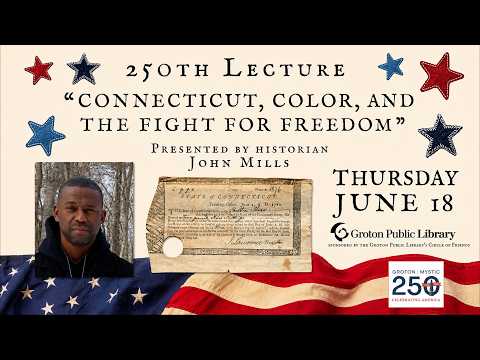
Genealogist John Mills traces Black military lineages, uncovers cemetery erasures and calls for recognition
Summary
At a public talk, John Mills described how reverse genealogy connected him to enslaved ancestors, led to documented cases of cemetery erasure (including graves under a Baltimore parking lot), and highlighted the overlooked service of Connecticut's Black regiments such as the 29th Connecticut Colored Regiment.
John Mills, a software architect and genealogist, told a Thursday evening audience that tracing his family tree revealed enslaved ancestors and a pattern of burial-site erasures that he said link personal history with broader omissions in public memory.
Mills said his research led him to Hickory Grove Cemetery in Kilgore, Texas, to Baltimore's Laurel Cemetery and to records showing multiple generations of Black men serving in U.S. conflicts. "When I heard it, my shoulders kind of went back. It was like I'm really—I really am from here," he said, describing how discovering primary documents changed his sense of belonging.
Mills recounted discovering family death certificates and headstones that established ties to ancestors who were enslaved and buried in segregated cemeteries. During the talk he described Laurel Cemetery in Baltimore as a site where, he said, ground-penetrating radar work identified a very large number of unmarked graves beneath a shopping-center parking lot; Mills reported that researchers and descendants are sharing records to identify individuals from those burials. "There are some 30,000 undescribed grave[s] under that parking lot," he said, presenting that figure as the result of archaeological work and ongoing research.
The presentation tied these findings to military history. Mills outlined Connecticut's shifting laws and practices — including the 1792 militia rules, the state's 1818 constitution and later Civil War-era laws — that in his account excluded Black people from franchise and military recognition for long periods. He focused on the 29th Connecticut Colored Regiment, describing how the regiment was mustered late in the Civil War to meet recruitment quotas, entered Richmond in April 1865 and yet has been incompletely commemorated in Connecticut.
Mills cited memoirs and primary sources showing unequal treatment of Black soldiers: withheld enlistment bonuses, lower pay, and reports that wounded Black soldiers sometimes received slower medical attention on the battlefield. He said descendants had to raise substantial funds to erect a New Haven monument and that the monument lists about 1,000 names while recruitment records show approximately 1,700 men associated with the regiment.
Explaining his method, Mills described "reverse genealogy," a process of starting with a historical person and tracing forward to living descendants, then producing narratives and public commemoration projects (plaques, murals, ceremonies). He said his nonprofit works with descendants to restore names and narratives "and then we attempt to inject those people into the communities where they lived, worked, or died." Mills said he has published a book (The Narrative of Primus) and plans to publish another (Dissonance) and that a film based on his research is in the festival circuit.
Mills framed the work as corrective: adding context and names to histories that, he said, often emphasize a handful of well-known figures while leaving out large numbers of ordinary Black Americans whose service and lives shaped local and national history. He described multiple family lineages where service in the Revolutionary War, Civil War and later conflicts recur across generations.
Mills urged audiences and institutions to recognize those lineages and burial sites and to involve descendant communities in restoration and commemoration efforts. He said researchers and descendants are cooperating to provide documentation to projects attempting to map and memorialize lost graves. He also noted forthcoming publications and a film screening tied to that work.
The talk closed with Mills offering copies of his recent book and saying a second revision of a collaborative book would be released on Sept. 1; he said a film connected to the research will screen locally next year.