Get Full Government Meeting Transcripts, Videos, & Alerts Forever!
Get email alerts on the Capital Improvement Plan topic
No spam. Unsubscribe anytime.
Planning Commission unanimously recommends 2027–2032 CIP, citing $25.6M in proposed investments
Summary
The Monroe Planning Commission voted unanimously June 8 to recommend the 2027–2032 Capital Improvement Plan to city council; the draft CIP lists about $25.6 million in projects across utilities, parks, transportation and facilities, though most items are not yet fully funded.
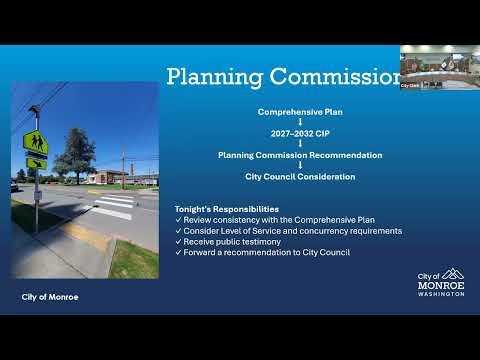
The Monroe Planning Commission voted unanimously June 8 to recommend the city’s draft 2027–2032 Capital Improvement Plan to the Monroe City Council.
Jordan Otto, the city’s public works operations manager, told the commission the proposed six-year CIP identifies roughly $25.6 million in planned investments across transportation, parks, utilities and public facilities and is intended to guide grant applications, impact-fee planning and budget discussions rather than to authorize construction. “The proposed CIP includes approximately $25.6 million in planned investments across transportation, parks, utilities, and public facilities,” Otto said during the public hearing.
Otto highlighted example projects that illustrate the plan’s mix of maintenance and growth investments. He described a 2027 police evidence-room HVAC improvement intended to preserve evidence integrity and meet accreditation standards; staff estimated that project at about $53,000. He also described a prioritized utilities project — a 12-inch Ingram cast-iron water-main replacement — scheduled for 2027 with an estimated cost of $1.8 million, which staff said would reduce the risk of breaks and potential hillside erosion.
Commissioners asked technical questions about how the CIP ties to the comprehensive plan, the city’s transportation improvement plan and jurisdictional limits for highway crossings and sidewalk projects. Otto said many projects listed in the CIP are not fully funded today and that future prioritization and funding decisions rest with the City Council through budget and capital processes.
After the hearing closed with no public testimony, Commissioner Carla moved that the commission adopt the draft findings and recommend Council approve the 2027–2032 CIP update to the capital facilities plan; a colleague seconded the motion. The chair called the question and the motion carried by voice vote; the commission recorded the outcome as unanimous.
Next steps: the Planning Commission’s recommendation will be transmitted to the Monroe City Council, which will consider project prioritization, funding and any ordinance or budget actions in the coming months as part of its budget process.