Get Full Government Meeting Transcripts, Videos, & Alerts Forever!
Get email alerts on the Child Welfare Services topic
No spam. Unsubscribe anytime.
Task force hears DCS, providers say home-based services and foster-home capacity remain strained; federal funding window seen as opportunity
Summary
At a Child Welfare Task Force meeting, DCS leaders, providers and youth representatives outlined workforce and placement shortages, noted uneven access to psychological evaluations and housing vouchers, and identified interagency coordination and targeted pilot projects as next steps.
The Indiana House Child Welfare Task Force heard detailed presentations from Department of Child Services officials, providers and youth representatives about persistent gaps in home-based services, clinician capacity and foster-home availability.
Amanda Ressler, chief deputy of child welfare services, summarized the mismatch between children in care and licensed homes: "We have 8,778 kids in care," she said, and later provided the inventory breakdown—497 relative/kin homes, 1,532 nonrelative DCS homes and 1,744 licensed child-placing agency (LCPA) homes—noting the current supply falls well short of a one-to-one ratio.
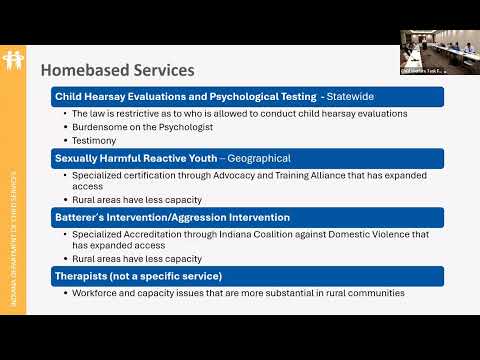
Presenters and providers told the task force that several factors converge to limit service access: a statewide shortage of licensed therapists and clinicians in rural counties, burdens tied to child hearsay and psychological evaluations (comprehensive reports can take many hours and are poorly reimbursed), and a housing market that leaves older youth with limited voucher availability. DCS staff noted the state spends roughly $40 million on home-based case work and that category has become a catch-all with few standardized KPIs.
On clinical evaluations, speakers described legal and practical constraints: Indiana law requires child hearsay evaluations be performed by a psychiatrist, psychologist or medical doctor, and several speakers said lengthy evaluation timelines and court-testimony burdens discourage clinicians from taking these cases, particularly outside urban centers. A DCS official estimated reimbursement was "close to $200 per hour," and participants recommended considering a per‑occurrence payment structure to improve timeliness and access.
Speakers also flagged placement mix and acuity as central constraints: some licensed homes cannot accept medically fragile children or large sibling groups; recruitment and retention remain difficult (several presenters reported losing newly trained clinicians and foster parents within a year); and foster-youth housing vouchers are not consistently available across regions (one provider said only about a dozen spots were open in South Bend at the time of the meeting).
To address these problems the task force discussed several directions: expanding prevention and family-resource efforts (members described family resource centers as community-led and unevenly distributed), piloting technology and predictive-analytics tools to better match services to family needs, and improving cross-agency coordination so juvenile courts, DCS and mental-health systems work from consistent incentives. A participant noted federal reimbursement for prevention and preservation services will increase to about 66% in October, a funding opportunity the group identified for scaling preventive programs.
Task force members agreed to move from broad discussion to targeted action items: compiling priority bullet points before the next meeting, exploring models used in other states (New Jersey was cited for mobile crisis and systemwide coordination), and examining whether statutory or executive requirements would help break interagency silos. Representative Dale DeVon closed by urging continued engagement: "We got to keep fighting the fight," he said.
The task force did not take formal votes at the meeting but members asked staff to circulate the new slides and service-utilization findings for further review and to prepare suggested priorities for the next session.