Get Full Government Meeting Transcripts, Videos, & Alerts Forever!
Get email alerts on the Antitrust Enforcement topic
No spam. Unsubscribe anytime.
Mr. Raskin urges tougher antitrust oversight, links Spirit Airlines collapse to Iran war and industry consolidation
Summary
In an opening statement to the House Judiciary committee, Mr. Raskin said the president's "disastrous and illegal war in Iran" and weakened antitrust enforcement contributed to Spirit Airlines' collapse and called for renewed oversight of merger approvals and enforcement practices.
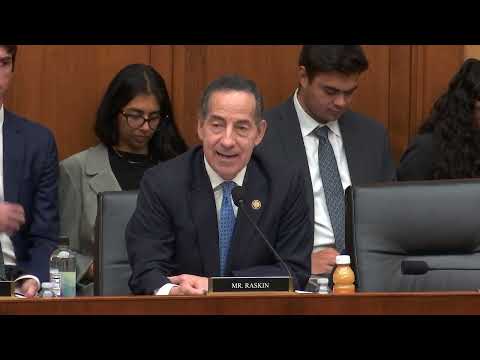
Mr. Raskin, a committee member, opened the hearing with an extended statement blaming the collapse of Spirit Airlines on the economic fallout of what he called the president's "disastrous and illegal war in Iran" and on growing market concentration in the airline industry.
He said the war has cost "American taxpayers more than $100 billion" and "American consumers more than $60 billion," and that increased fuel costs have averaged "more than $470 per American household." He argued those factors, and a reported doubling of jet fuel prices that forced Spirit to absorb about $100 million in unexpected costs over "a couple of months," were decisive for an ultra low-cost carrier that operates on thin margins. "That was a corporate death sentence," he said.
Raskin also framed the company's failure within broader industry consolidation. Citing an analysis he said showed extreme concentration of gains among a small number of firms, he stated that the four largest U.S. carriers once controlled roughly 60% of domestic traffic and now control about 80%, which he said raises prices and reduces competition and innovation.
He praised the Department of Justice's 2023 decision to block JetBlue's proposed acquisition of Spirit, saying the DOJ "protected consumers from increased costs" by preserving Spirit as a competitive, ultra low-cost option. Quoting the judge who upheld the DOJ decision, Raskin repeated that allowing JetBlue to acquire Spirit "would eliminate one of the airline industry's few primary competitors that provides unique innovation and price discipline."
Turning to enforcement more broadly, Raskin criticized what he described as a pattern of the current administration clearing major deals or settling cases on terms he viewed as favorable to large companies, citing recent approvals or settlements involving Nexstar–Tegna, Live Nation–Ticketmaster, and a Paramount-related transaction as examples. He said senior antitrust officials who raised concerns had been pushed out or fired, and argued this shift in enforcement has contributed to higher prices and fewer choices for consumers.
Raskin closed by urging Congress to perform "serious oversight of an antitrust enforcement system" he said has been "twisted and corrupted," and to resist proposals that would reduce scrutiny of mergers. The statement was presented as his opening remarks to the committee; no formal votes or motions were recorded in the transcript.