Get Full Government Meeting Transcripts, Videos, & Alerts Forever!
Get email alerts on the Animal Safety topic
No spam. Unsubscribe anytime.
Clark County officer warns pets can overheat in minutes, explains legal steps for rescuers
Summary
A Clark County Animal Protection and Control officer warned residents that vehicles can reach deadly internal temperatures in minutes, described signs of animal heat distress and outlined the five legal steps—including calling 911—required under Washington law before forcibly removing an animal from a vehicle.
An animal control officer for Clark County Animal Protection and Control urged pet owners and bystanders to act quickly in summer heat, saying vehicles can reach dangerous internal temperatures within minutes and advising clear steps for safely helping animals.
The presenter said about 70°F outside is a practical threshold for concern about dogs left in vehicles and noted factors that raise risk, including direct sunlight, the animal’s age, body condition, breed (short-nosed breeds), dehydration and stress. "Around 70 degrees is when we start getting concerned," the officer said, adding that interior car temperatures can spike rapidly and that at 75°F outside a car’s interior can reach roughly 100°F in about ten minutes.
The officer warned that "anything over 104 degrees of internal temperature is severe brain damage," and described heat-exhaustion and heat-stroke signs to watch for: excessive panting or drooling, pale or dark gums, vomiting, collapse, seizures or other neurological symptoms. "If a cat is panting, it's a problem," the officer said, calling panting in cats unusual and a sign of severe overheating.
The presentation reviewed local legal protections for rescuers and the practical steps to follow before entering a vehicle. Citing provisions in the Revised Code of Washington and the RCW section on removal of vulnerable persons or domestic animals, the officer listed five requirements for Good Samaritan removal: determine the animal cannot exit on its own; have a good-faith belief the animal faces imminent danger; notify law enforcement or call 911 before entry; use no more force than necessary (breaking a window as a last resort); and remain with the animal in a safe location until responders arrive. "Call 911," the officer said; "it’s going to be the fastest way to get help."
The presenter gave a short mnemonic for bystanders: A — assess distress; B — be willing to take photos or video as evidence; C — call 911; D — don't leave and be as descriptive as possible about location/vehicle; E — enter only if necessary. On breaking a window, the officer advised breaking the window furthest from the animal to avoid causing injury with glass and to break only one window.
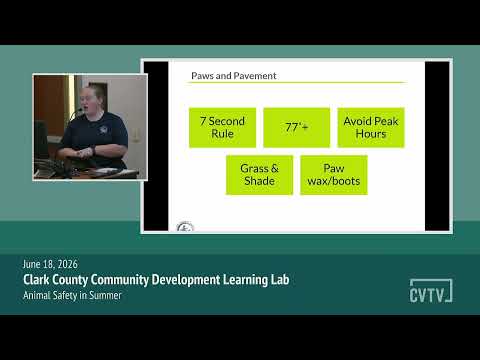
The officer also covered other summer-safety guidance: a seven-second 'paws on pavement' test to judge surface heat (place the back of the hand on pavement; if you cannot comfortably hold it for seven seconds, it’s too hot for paws), advice on water-safety and life jackets, the risk of algae blooms in local waters, and transport rules for animals. The officer cited Clark County code 8110708, which makes it unlawful to transport or confine an animal on the outside part of a motor vehicle unless it is secured by harness, leash, cage or other enclosure that protects the animal from falling and prevents it from leaving while unattended.
For lost-and-found pets and licensing, the officer recommended keeping microchip and tag information current, checking the Humane Society for Southwest Washington lost-and-found pages, using Petco Love Lost reports, and provided Clark County Animal Protection and Control contact details: office at 500 West Eighth Street, Suite 100, Vancouver; general line (564) 397-2488; licensing line (564) 397-2489; and animal@clark.w.gov. Local emergency veterinary options named included Pacific Northwest Pet Air and Specialty Center, MedVet Vancouver and Columbia River Veterinary Specialist.
During the Q&A, the officer reiterated there is no fixed number of minutes that determines distress; assessment depends on the animal’s condition and environmental factors and that severe harm can occur within 5–10 minutes in very hot conditions. A resident asked whether food or water inside a vehicle makes a difference; the officer replied it does not negate dangerous air temperatures. The session closed with a notice of a follow-up learning lab on July 16 at 11 a.m.
The presentation combined medical guidance, legal context and practical steps for residents and bystanders to reduce summer heat risks to animals and to act lawfully when intervention appears necessary.