Get Full Government Meeting Transcripts, Videos, & Alerts Forever!
Get email alerts on the Student Assessment topic
No spam. Unsubscribe anytime.
New Berlin board reviewed spring screening data and flagged cohort and subgroup gaps
Summary
District staff presented spring universal screener results showing strong third-grade reading fluency but cohort declines in some reading and math measures and persistent gaps for economically disadvantaged students and some special-education subgroups. The board directed staff to continue root-cause analysis and summer planning with principals.
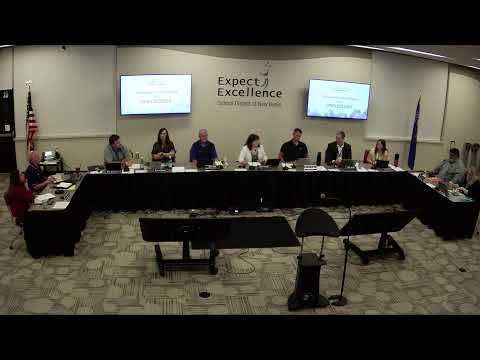
The School District of New Berlin heard a detailed report on spring universal screening results and subgroup trends during its regular board meeting. District assessment staff said the screeners — administered three times a year using FastBridge/AsWebPlus — are intended to inform instruction rather than serve as state accountability measures.
"I am Amanda Mazerkowitz. I'm the director of student services for our school district," said Amanda Mazerkowitz, who introduced the presentation and described how the district uses screening data to identify students who need targeted interventions. Director of elementary schools Matt Seski walked the board through grade-level and cohort results and subgroup comparisons.
Seski highlighted an area of strength in early reading measures: "91% of the third graders are fluent currently," he reported, noting that cohort comparisons show different groups of students year over year and that the measures are not always the same students tracked across grades. He also pointed to cohort declines that staff plan to investigate further: in some cohorts third-grade proficiency rates (for one reported reading measure) fell from the mid-80s to the high-70s or mid-70s as those students moved to the next grade, and similar drops were noted on some math measures.
Staff emphasized subgroup monitoring. For example, on one elementary math screener this spring, 57% of economically disadvantaged students were at or above the benchmark versus 84% for students not considered economically disadvantaged; these gaps remain a focus for targeted supports. The presenters also explained the district’s approach to students with 504 plans and students with Individualized Education Programs (IEPs): unlike many special-education services that can be partially reimbursed through federal or state aids, supports tied to 504 plans do not automatically generate supplemental state/federal reimbursement and therefore rely on the district’s general fund.
Board members asked about statewide comparisons. Staff said statewide Forward/ACT results were not yet available for a formal cross-district comparison; universal screening data are intended primarily for local instructional planning. The board also heard about summer work: principals and coaches will run data protocols on identified cohorts and individual students, prioritize intervention plans, and examine why some students drop below proficiency from one year to the next.
The board did not take formal action on the screening presentation but directed staff to continue the root-cause analysis over the summer and to include findings in upcoming goal-setting workshops. The next steps include school-level reviews with principals and posting an updated data dashboard for the 2026–27 school year.