Get Full Government Meeting Transcripts, Videos, & Alerts Forever!
Get email alerts on the Public Comment Policy topic
No spam. Unsubscribe anytime.
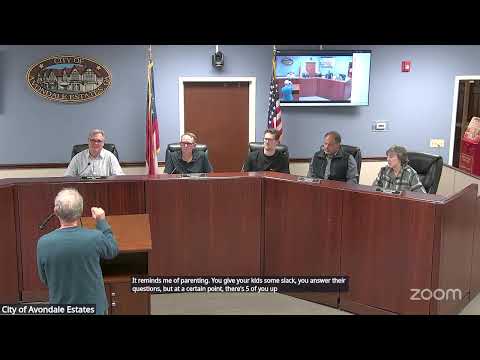
Avondale Estates commissioners split over proposed public-comment rules
Summary
At a Feb. 24 work session the Avondale Estates Board of Mayor and Commissioners debated a proposed resolution restricting public-comment dialogue and limiting duplicate comments during same-night public hearings; the board delayed a vote until March 11 after extensive debate and public input.
The Avondale Estates Board of Mayor and Commissioners spent much of its Feb. 24 work session debating a proposed resolution that would formalize when and how members of the public may address the board.
The draft resolution, prepared by the city attorney and circulated in the board packet, would move the primary public-comment period to the start of regular meetings, require questions intended for staff to be submitted in writing in some circumstances, and prevent a person from making the same comment twice when a public hearing on the same issue is held the same night. Attorney Quinn told the board the goal is “to prevent duplication of the same topic by the same person within the same meeting” and to avoid very long, repetitive sessions for contentious zoning matters.
Commissioners divided over how strictly to limit in-meeting dialogue. Several members argued that answering questions from the public during comment periods quickly leads to extended back-and-forths that derail the agenda and create unequal opportunities for members of the public. One commissioner said, “As soon as the foot’s in the door, it becomes a different thing,” urging a bright-line approach to prohibit responses that would open spontaneous dialogue.
Other commissioners and members of the public urged a more flexible approach. They proposed small procedural changes—such as providing a public-comment card, allowing brief clarifying questions, or ensuring written questions receive a public response after the meeting—to preserve residents’ access while preventing meetings from running off the rails. Commissioner Smith and others suggested staff could circulate written responses to questions submitted at the meeting so the larger public benefits from the information.
Attorney Quinn said subsection E is aimed specifically at preventing a speaker from repeating a comment both during a general comment period and again inside a concurrent public hearing on the same agenda night, noting that omission “could really make for a very long meeting” for sizable zoning controversies.
The board did not vote on the draft on Feb. 24. Members agreed to continue refining the language, and the resolution will be presented for consideration at the March 11 regular meeting. Members signaled interest in clarifying how written questions and staff responses would be disseminated to the public—by posting to the city website or noting them in a subsequent meeting—before final adoption.