Get Full Government Meeting Transcripts, Videos, & Alerts Forever!
Get email alerts on the Land Use topic
No spam. Unsubscribe anytime.
Commission explores returning part of Mount Pleasant Center property to tribe, asks staff for options
Summary
City commissioners discussed returning all or part of the former Mount Pleasant Center property to the Saginaw Chippewa Indian Tribe, and weighed alternatives including a solar field, recreation and limited affordable housing within state-use constraints; commissioners directed staff to prepare option packages for future consideration.
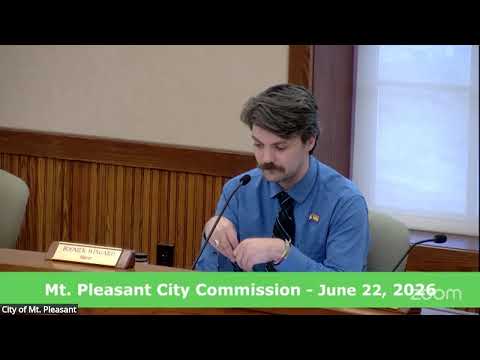
The Mount Pleasant City Commission spent more than an hour on June 22 weighing options for the former Mount Pleasant Center property, including returning all or part of the site to the Saginaw Chippewa Indian Tribe, using portions for recreation, or pursuing revenue-generating uses such as a solar farm.
Commissioners said they heard during a previous work session there was interest in conveying at least a portion of the parcel to the tribe. Several members urged a deliberate approach rather than an immediate vote: the commission did not approve a conveyance at the meeting but directed city staff to prepare concrete plans showing combinations of conveyance, recreation and revenue-generation for future formal consideration.
Why it matters: the parcel has been the subject of competing proposals that range from tribal return to mixed-use development. Commissioners noted a state legal restriction that constrains how city-owned lands acquired for public purposes may be used, which limits the city's ability to pursue projects that primarily generate revenue from the site. Because of that restriction, several commissioners said partial conveyance (conveying only a portion while retaining space for public uses) may be the most practical path forward.
At the meeting, commissioners repeatedly requested that staff draft option packages that illustrate specific scenarios: full conveyance to the tribe; mix of conveyance and recreation; mix of conveyance, recreation and revenue generation (for example, a solar installation paired with parkland); and a no-action baseline. Manager Sans said staff would return with cost and feasibility estimates and recommended next steps.
Public commenters urged patience and broader community engagement. Resident James Marino told the commission he had begun talking to state legislators about changes to state law that could expand permissible uses of the parcel, and urged commissioners to be patient before selling the land. Another resident asked whether tribal ownership would change what could be built on the property if deeded to the Saginaw Chippewa Indian Tribe; commissioners did not provide a legal opinion at the meeting and said staff would examine those questions.
What happens next: staff will develop option packages and numerical estimates for the commission, to be discussed in a future work session or regular meeting. No formal motion to convey the property was adopted on June 22.