Get Full Government Meeting Transcripts, Videos, & Alerts Forever!
Get email alerts on the City Administration topic
No spam. Unsubscribe anytime.
Adrian commissioners interview finalists for city administrator; candidates prioritize water fixes, blight enforcement and fiscal restraint
Summary
At a June 22 special meeting the Adrian City Commission interviewed multiple finalists for city administrator and a council candidate. All four administrator candidates prioritized addressing the city's water problems and aging infrastructure, while also offering differing blends of enforcement, grantsmanship and community outreach to tackle blight, budgets and staffing gaps.
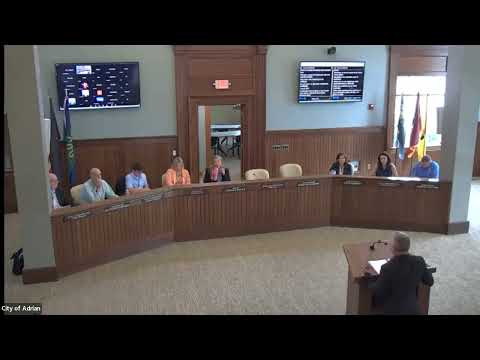
The Adrian City Commission on June 22 conducted a series of public interviews with finalists for the city administrator role and a candidate for city council, focusing repeatedly on the city's water problems, aging infrastructure and blight removal.
Mayor Angie Sword Heath opened the special meeting and the commission conducted sequential interviews with candidates Jason Smith, Jeremy Davies, Ali Awadi and Shannon Spilman. Commissioners asked each candidate how they would translate commission priorities into staff mandates, manage employee performance, steer capital projects when funds are short, and respond to public opposition.
Water emerged as the dominant issue. Jeremy Davies said the city's immediate concern was clear: "the water issue," and urged an action plan that the commission and the public would endorse. He told commissioners a one-year evaluation should include adoption of a concrete plan to address water treatment and service-line problems and measurable improvements in staff culture and communication.
Several candidates described different paths to the same goal: using outside funding and technical assistance to accelerate repairs. Jason Smith said he is a "grant hunter" and recounted securing a million-dollar CDBG grant in a prior role; he also emphasized zoning and code enforcement as tools to reduce blight and described a mix of firm enforcement and neighborly outreach, invoking the "broken window theory" to explain how standards can shift neighborhood norms. Ali Awadi said he had worked to build federal relationships and pursued EPA assistance through the federal "Get the Lead Out" initiative in a previous job; he described outreach and town halls to calm opposition while advancing remediation. Shannon Spilman said she had signed a $10.3 million EAGLE grant at her current municipality and was overseeing construction of a new water tower and treatment work there, and she described coordinating a joint street-and-water project that nearly halved the local street-repair cost.
Budget and staffing were recurring themes. Candidates acknowledged recent staff reductions in Adrian and said any restoration of positions should be tied to stable revenue and to prioritization. Jeremy Davies noted the difficulty of measuring an administrator's first year but recommended a mix of tangible goals (specific street repairs, budgetary metrics) and qualitative indicators (staff feedback). Jason Smith and Shannon Spilman both highlighted experience negotiating with TIF districts, engineering firms and grant programs to expand capacity without immediate tax increases.
On governance and operations, candidates agreed staff must be protected from ad hoc direction by individual commissioners. Jason Smith described the importance of keeping roles separate and bringing requests through formal channels; Ali Awadi and Shannon Spilman said they would shield staff and escalate elected-official requests to the administrator's office for transparent handling.
The commission took no formal votes at the meeting. After the interviews the commission opened the meeting for public comment, recorded no speakers in chambers or on Zoom, and adjourned.
The commission is expected to continue its hiring process in subsequent public or closed sessions as it evaluates candidates and checks references.