Get Full Government Meeting Transcripts, Videos, & Alerts Forever!
Get email alerts on the Preliminary Budget topic
No spam. Unsubscribe anytime.
Volusia County Schools presents preliminary 2026–27 budget, outlines $6.34M projected deficit and five‑year capital priorities
Summary
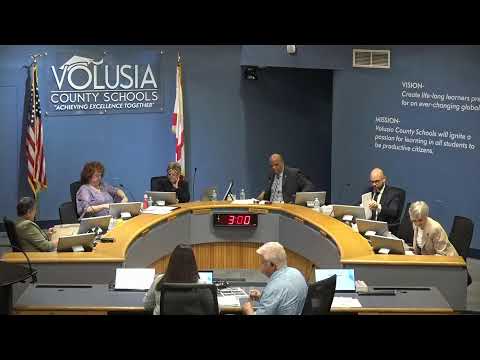
At a June 23 workshop, Volusia County Schools officials said the preliminary 2026–27 budget reduces the operating deficit to $6.34 million but still projects revenue pressures tied to declining enrollment and scholarship program pass-throughs; staff also detailed major capital projects in a five‑year plan.
Volusia County Schools officials presented a preliminary 2026–27 general fund budget on June 23 that reduces a projected operating deficit but leaves the district facing persistent revenue pressures tied to enrollment shifts and scholarship pass‑throughs.
"If you take one thing away from this meeting, please let it be this," Chief Financial Officer Deja Wittenberger said, adding that "Volusia County is proactively aligning our resources while prioritizing our support for our students and schools." Wittenberger told the board the district expects the operating deficit to fall from $14.79 million in the current year to $6.34 million in the 2026–27 preliminary budget.
Wittenberger attributed much of the pressure to slower growth in the state Base Student Allocation (BSA) and the movement of dollars into scholarship and charter programs. She said the BSA rose from $5,372.60 to $5,457.60 — an $85 (1.58%) increase — and that the teacher salary increase allocation rose about 1.06%, roughly $4.2 million for the district. She also said the Family Empowerment Scholarship is "roughly $99 million" in pass‑through payments this year (including a projected $15 million increase) and that charter school payments total about $33 million.
Those shifts, Wittenberger said, contribute to a funding gap when compared with cumulative inflation. She noted a proposed slight reduction in the employer contribution rate for the Florida Retirement System, which she characterized as a modest savings amid broader cost increases.
On staffing and cost‑management, the preliminary budget includes approximately $1.4 million in district‑level staffing reductions (largely through attrition and reorganization), about $1.4 million in school‑level staffing adjustments tied to enrollment, and roughly $0.5 million in savings from lower state retirement contribution assumptions. Wittenberger said general fund expenditures remain heavily weighted toward personnel, with about 80% of the fund supporting salaries and benefits and roughly 83% of budgeted positions classified as school‑based.
When a board member asked about an apparent $78 million decline in the beginning‑year fund balance (from about $111 million currently to $33 million projected for 2027), Wittenberger explained the comparison reflects timing differences — the current figures are captured through February, while many expenditures and purchase orders will be charged through June — and that the fiscal year is projected to end with about $30 million in fund balance, roughly the district's 5% target.
Ron Young, director for construction and planning, presented the five‑year capital outlay work program for fiscal years 2027–31. He identified several major projects that staff have placed on the forecast, including an Atlantic High School CTE building addition with an aerospace hangar and six classrooms; a DeLand Middle master plan and DeLand High School roof replacement; a facilities warehouse expansion intended to combine two warehouses and eliminate a $300,000 annual lease; a Pathways Elementary 11‑classroom addition; Silver Sands Middle remodeling; and Spruce Creek Elementary HVAC replacement. Young said some projects may be reordered to capture cost savings and that the Citizens Oversight Committee recommended furniture and fixture replacements at multiple campuses in the early years of the plan.
Board members asked several follow‑up questions during a lengthy discussion. Mrs. Jessie Thompson praised the clarity of the presentation and asked whether the five‑year plan is fluid; Wittenberger and Young said it is, and that staff will continue to evaluate priorities and timing. Board members also pressed for more detail on where staffing reductions occurred; Wittenberger said reductions were determined at the department level and varied by function, and she offered to provide a list of eliminated positions upon request.
Several trustees raised policy and equity concerns tied to declining enrollment and extra‑pay activities. The board discussed Policy 616 (the district's re‑imaging/rezoning worksheet), with staff saying this is the first year the worksheet has been used and that staff expect to review it, revise as needed, and share results with the board around September. Trustees noted that rezoning or school closure processes typically require community engagement and can span roughly six months, meaning changes decided during the year often take effect the following summer.
A recurring theme in discussion was extracurricular access. One board member urged the district to "get rid of pay‑to‑play" fees or otherwise modify the structure to reduce barriers to sports, arts and music, while acknowledging a potential budgetary impact if fees are eliminated. Trustees also emphasized considering special education (ESE) populations, campus safety and staffing ratios when evaluating capacity and possible closures.
The workshop concluded with staff offering to provide more detailed position and fund‑balance documentation and a reminder that the board will receive additional re‑imaging material in September. The board adjourned and scheduled a consent session for 4:30 p.m.
The district did not take formal votes on budget adoption at the workshop; the presentation was framed as preliminary and meant to guide later action and public input.