Get Full Government Meeting Transcripts, Videos, & Alerts Forever!
Get email alerts on the Homelessness Shelter topic
No spam. Unsubscribe anytime.
TVCCA and St. Mark’s seek permission for winter shelter at 248 Broadway as neighbors split
Summary
Thames Valley Council for Community Action and St. Mark’s Lutheran Church asked Norwich’s planning commission for a special permit to operate a seasonal cold‑weather shelter at 248 Broadway. Supporters cited recent deaths and TVCCA’s experience; opponents said the 58‑bed proposal is too large for the residential neighborhood. The hearing was continued to July 25 for additional materials.
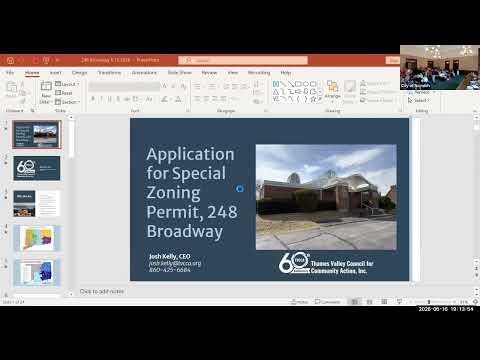
The Norwich Planning Commission on June 16 heard a packed public hearing on a special‑permit application from the Thames Valley Council for Community Action (TVCCA) and St. Mark’s Lutheran Church to operate a seasonal overnight cold‑weather shelter at 248 Broadway.
Josh Kelly, CEO of TVCCA, told the commission his agency would partner with St. Mark’s to run an overnight shelter during the cold months (mid‑November through mid‑April, with operational hours generally between 6 p.m. and 8 a.m.). He said the proposal would preserve the church’s existing religious and community uses while allowing TVCCA to provide expanded overnight capacity, register and track guests, and offer case management and referrals to housing services. Kelly said the state has already set aside funding for Norwich cold‑weather sheltering and described operational safeguards: on‑site staff during operating hours, metal‑detector screening, camera surveillance around the building perimeter and coordination with the fire marshal and building officials.
“People are dying,” Kelly said in his presentation, citing data TVCCA had collected: he reported roughly 212 people in the Norwich ZIP code identified as literally homeless in a recent count and additional individuals listed as imminently homeless. He told the commission TVCCA had operated a cold‑weather shelter over two winters and that while the proposed maximum capacity at St. Mark’s is 58, the organization expects average nightly use “realistically between 10 and 30” and noted a recorded peak night of 45 guests in 2025‑26.
Pastor Eric Heinrich of St. Mark’s described the congregation’s long record of community meals and outreach and framed the special permit as an extension of the church’s hospitality. “Granting a special permit … will demonstrate that Norwich is ready to move forward and provide additional care,” he said.
Public comment stretched for hours. Dozens of residents, faith leaders and service‑provider representatives addressed the commission. Supporters included representatives of local homeless‑service organizations and multiple neighbors who said they had not experienced problems from existing church activities and urged the commission to approve the permit to prevent deaths in winter. A number of speakers described personal experience with homelessness or family members who had been homeless and urged more shelter capacity.
Opponents — including a neighborhood association, several abutting property owners and multiple residents living near St. Mark’s — raised zoning, safety and process objections. They said a 58‑bed, low‑barrier seasonal shelter would change the character of an essentially residential district, questioned whether the church property was the appropriate regional site, and urged the commission to require clearer, enforceable operational details. Some opponents cited missing or incomplete application materials and asked that the commission require final site plans and stronger written commitments before granting a permit.
Neighborhood concerns that frequently recurred during testimony included daytime impacts (where guests go between nightly operations), parking and vehicle traffic, the adequacy of security outside the property, potential spillover impacts if the shelter reaches capacity, and whether TVCCA’s written filings matched public statements made by its leadership. Supporters emphasized TVCCA’s existing programs, proposed intake and screening protocols, staff presence overnight and the organization’s goal of connecting shelter guests to housing and job programs.
The commission did not make a decision. It continued the public hearing to July 25 to allow TVCCA and other parties time to submit additional documentation, address questions raised by neighbors and staff, and for the commission to consider potential conditions that would be enforceable if a permit were granted.
What’s next: The public hearing record will remain open until the continuation on July 25. The commission asked that parties not repeat testimony already on the record unless they are offering new information; the record of comments already submitted will be part of the file reviewed at the continued hearing.
Speakers quoted: “People are dying,” Josh Kelly said, describing TVCCA’s rationale for adding shelter capacity. Pastor Eric Heinrich said the church’s ministries “have fed, clothed, and provided other services for unhoused citizens for years” and urged approval.
Clarifying details: The proposal is for a seasonal shelter (mid‑November–mid‑April), adults only (age 18+), with a stated maximum capacity of 58 but a TVCCA‑stated expected average of roughly 10–30 guests per night; TVCCA reported an operational peak of 45 guests in a single night in 2025‑26. TVCCA said state funding has been allocated to support Norwich cold‑weather sheltering; details of ongoing operating funding and final site‑plan adjustments were not finalized in the hearing record and were requested by the commission.
The hearing was continued to July 25, 2026, for further submittals and deliberation.