Get Full Government Meeting Transcripts, Videos, & Alerts Forever!
Get email alerts on the Taskforce Overview topic
No spam. Unsubscribe anytime.
Norwalk task force readies citywide survey, branding push and chapter-by-chapter sustainability report
Summary
At its March 19 meeting, the Norwalk Sustainability & Resilience Task Force agreed to short, topic-focused community surveys, reviewed subcommittee recommendations on energy, mobility, waste and resilience, and launched a branding effort to boost outreach ahead of an April 25 Earth Day event.
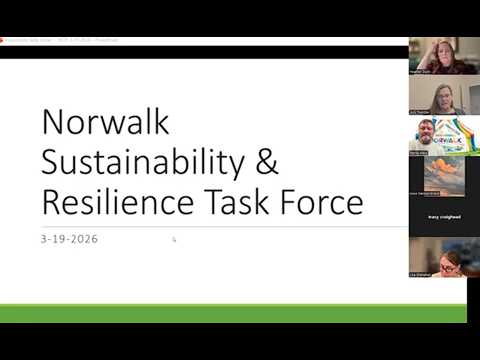
The Norwalk Sustainability & Resilience Task Force met virtually on March 19 to review draft recommendations from subcommittees, set a strategy for community outreach and begin branding work ahead of Earth Day.
Moderator Jody opened the meeting and asked teams to follow a uniform report structure so each sector can be compiled into a single citywide sustainability chapter. “Each team will be a separate chapter for the report,” Jody said, asking members to standardize outlines and cite sources from the shared Drive folder.
Energy subcommittee member Diane Laurella said the group is refining an outline and will study technologies and policies including community solar, heat pumps and solar carports. “We don’t need to recreate the wheel — pull ideas from other cities and cite your resources,” Diane said, urging teams to verify material and to include where ideas came from.
Mobility leads proposed mode share (walking, biking, transit) as a key metric and flagged recent transit improvements and ridership trends. Paul said Norwalk Transit District supplied ridership data while Metro-North data will require a records request; another member noted bus ridership rose about 13% year-over-year and suggested using Earth Day and neighborhood association meetings to capture geographically representative survey responses.
Waste team members announced a Skip the Plastic harbor cleanup on Earth Day and a proposed local ordinance to limit some single-use plastics; they emphasized optimizing food donation, composting and recycling to reduce municipal disposal costs, which one presenter estimated exceed $100 per ton.
Several teams highlighted open items to resolve: buildings recommended energy-benchmarking and solar-ready requirements as near-term measures; natural resources flagged private well vulnerability and the need to maintain an up-to-date open-space inventory; health and happiness advocates proposed low-cost social-health measures and a youth mental-health pipeline.
Participants discussed survey design and distribution strategy at length. Randy, who will lead survey work with the city’s community-engagement team, recommended short, focused surveys (around 10 questions) rather than a single, long questionnaire to avoid low response rates. Jody asked each subcommittee to draft priority questions to be collected in the shared Drive for final editing and distribution.
Branding and outreach received substantial attention. Volunteers presented logo concepts and three-word framing ideas (resilient, sustainable, connected). Organizers discussed using the Earth Day event on April 25 to promote the task force and to collect survey responses in person at vendor tables and neighborhood outreach events.
The meeting closed with logistics for Earth Day volunteer recruitment and a plan to meet in person for the next task-force meeting on April 15 at Lockwood Mansion. Teams were asked to fill the shared spreadsheet with objectives, suggested actions, metrics and approximate timelines so the staff coordinator can compile the citywide report.