Get Full Government Meeting Transcripts, Videos, & Alerts Forever!
Get email alerts on the Pensions topic
No spam. Unsubscribe anytime.
LCPR work group narrows scope to probation officers and 911 telecommunicators after debate over mixed service and costly past-service buybacks
Summary
At a Legislative Commission on Pensions and Retirement work group meeting, presenters ran hypothetical calculations showing large actuarial costs for past-service purchases and different outcomes under combined-service annuities versus MSRS mixed-service rules. The group voted to limit immediate recommendations to probation officers and 911 telecommunicators while asking staff to draft memos and refine definitions.
The Legislative Commission on Pensions and Retirement (LCPR) work group on pensions spent its meeting examining how combined and mixed-service retirement rules affect benefit levels and who should be included in any new public-safety pension tier. Presenters walked members through hypothetical examples showing large actuarial costs for buying past service, and members voted to keep the work group's immediate scope focused on probation officers and 911 telecommunicators.
Aaron Leonard, a presenter who led the actuarial overview, told members the numbers sometimes contradict expectations: "I think sometimes conceptually we think something works a certain way, but when you actually look at the numbers, it may not work." Using Minnesota State Retirement System (MSRS) general and correctional plans as examples, Leonard showed that a hypothetical worker age 55 with a $75,000 high-five salary and mixed years of service might receive roughly $29,000 annually under a combined-service annuity (CSA) scenario but could see different totals (roughly $34,000 in Leonard's examples) if benefits are deferred or treated under MSRS's mixed-service approach.
The presenters emphasized how small design changes multiply into large costs. In one modelling example, a benefit that is actuarially equivalent to $51,000 at age 66 becomes roughly $29,550 a year at age 60, with a present value near $355,000 based on the actuary's assumptions. A proposed new-plan multiplier of 2.8 (compared with 1.7 in the general plan) produced much larger present values: Leonard showed an example where a member's benefit rose to $66,000 at age 66 with a present value around $794,000, representing the additional cost to the plan if such a change applied retroactively to past service.
Presenters and members discussed three common funding mechanisms for past-service purchases: (1) an individual pays the actuarial cost at retirement; (2) the employer or another government entity funds the cost; or (3) members use MSRS deferred-comp accounts to transfer funds into the pension plan. LCPR staff explained legal constraints under federal tax rules: mandatory employee elections to contribute in varying amounts are not permitted inside a tax-qualified defined-benefit pension plan, so deferred-comp accounts are often the practical vehicle to finance individual purchases. The staff also cited Minnesota statute 352.965, which contains processes to require employer participation in deferred-comp plans where relevant.
The group devoted substantial time to whether the work group's recommendations should expand beyond the two originally prioritized groups (probation officers and 911 telecommunicators) to include other public-safety-adjacent positions such as field-based forensic scientists. Representatives for forensic scientists urged inclusion, saying those staff respond to traumatic scenes and face public-safety risks in the field. Employer and county representatives warned that broadening coverage without more data could jeopardize the legislative pathway and make passage less likely.
After discussion, members put a motion to a vote to keep the immediate focus on probation officers and 911 telecommunicators. The motion carried by voice/hand count, with 14 members raising their hands in favor.
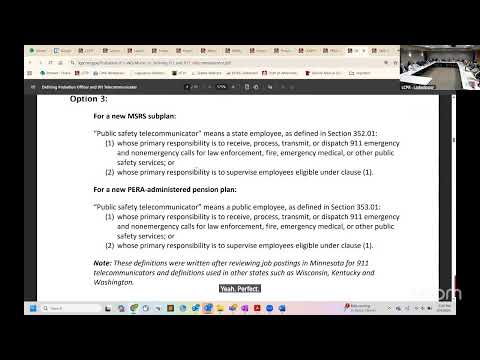
On definitions, LCPR staff presented three options for drafting eligibility language: (A) tie eligibility to specific statutory job classifications; (B) use function-based language describing direct supervision or delivery of probation/telecommunicator services; or (C) adopt a 'primary responsibility' test. Members debated trade-offs. County and employer representatives favored language that avoids frequent plan-entry/exit disruptions, prefers employer certification (to confirm duties), and protects promotional pathways; probation and telecommunicator advocates emphasized including supervisors who perform substantial field or operational duties. The group agreed to form small teams to refine definition text and return proposed language to the full work group.
Chairs and staff asked groups to prepare memos and recommended language for the next meeting; staff will assist with legislative drafting and a background memo for LCPR members. Meeting dates will be proposed on a roughly biweekly cadence.
Notes on authority and process: presenters referenced the session law mandate that formed the work group and cited statutory provisions for state employee definitions (section 352.01) and deferred-comp mechanics (section 352.965). LCPR staff said final policy decisions on whether and how to fund past-service purchases would require legislative action and clear funding sources.
What happens next: the work group will ask stakeholder teams to produce draft definitions and supporting data for the next meeting, and LCPR staff will draft explanatory memos and potential legislative language if the group reaches agreement. The group will not expand its immediate recommendation set beyond probation officers and 911 telecommunicators while it completes the actuarial and definitional work.
Quotes from the meeting: "I think sometimes conceptually we think something works a certain way, but when you actually look at the numbers, it may not work," Aaron Leonard said in an overview of the calculations. Devon, speaking for forensic scientists, said, "We represent the state forensic scientists," and urged consideration of field-based forensic roles. On the vote, a chair called for hands and the group approved staying with the two groups by a show of 14 hands.
The meeting adjourned after chairs committed to circulate next-meeting dates and to circulate assignment notes for the definition work groups.