Get Full Government Meeting Transcripts, Videos, & Alerts Forever!
Get email alerts on the Municipal Budget topic
No spam. Unsubscribe anytime.
Richmond Select Board outlines FY27 budget plan, seeks public feedback as ballot questions loom
Summary
At a special meeting the Richmond Select Board presented its proposed FY2026–27 municipal budget, which would raise the municipal tax rate by an estimated 3.98% if adopted and relies on $1.2 million in contributions to reserve funds while using $340,298 in unassigned funds to reduce the tax impact. Voters will decide an annual conservation reserve question and nine social-service appropriations on the Australian ballot.
The Richmond Select Board held a special meeting to present the proposed FY2026–27 municipal budget and to invite final public feedback before the budget goes to an Australian ballot in March.
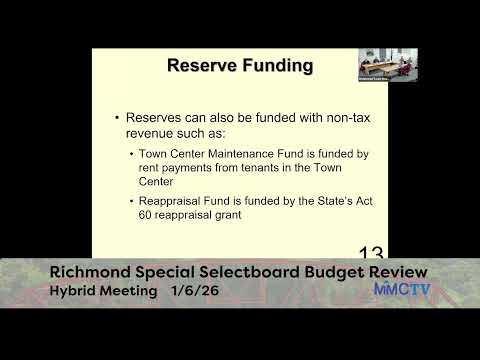
The budget proposal would increase municipal spending by roughly $985,000 compared with FY26, driven primarily by planned contributions to reserve funds and personnel cost adjustments. Using projected reimbursements and other receipts, the board proposes $1.2 million in contributions to reserve accounts for FY27, of which $680,000 would be raised through taxes and $540,000 would come from restricted or unassigned balances. The board also proposes applying $340,298 in unassigned funds to reduce the immediate tax impact.
Why it matters: the municipal tax rate in the FY26 budget was 0.5447; the board’s FY27 projection is roughly 0.5664 — about a 3.98% municipal increase. Because the school tax is set separately, the municipal portion represents roughly one quarter of a homeowner’s total tax bill; the presenter emphasized that the town cannot change school taxes. For a property assessed at $100,000, the municipal bill would rise by approximately $22 under the proposed budget.
Key budget features and department changes include a planned 3% increase to the employee wage grid (subject to final decisions in spring), a 20% increase in police wages adopted last fall to improve recruitment (the FY27 budget assumes 3.5 officers and a full chief), modest hourly increases for volunteer firefighters, and added hours for the assistant town clerk plus a temporary stipend to support a finance transition. Reserve spending planned for FY27 totals about $518,455 and includes police equipment (cruiser, radios, cameras), highway capital (dump truck, loader), fire turnout gear and minor building repairs, and library interior work.
Reserves, flood recovery and taxes: the board reviewed FY25 year‑end balances, which fell into the red after roughly $2 million in flood-related highway and other emergency spending. The town expects FEMA reimbursements and other receipts in FY26 that should restore reserves; the board said the current plan smooths reserve contributions over several years to avoid future large spikes or increased borrowing.
Ballot questions: the board detailed two sets of voter-facing questions that are separate from the municipal spending vote. First, an annual conservation reserve question would add one cent to the municipal tax rate and — based on the presenter’s grand-list estimate — would generate about $80,000 if approved (roughly $10 per $100,000 in property value). Second, nine charitable/social-service appropriations were warned for the Australian ballot after the board reviewed statutory guidance on which contributions must be separately voted; if all nine pass, they would add roughly $21,760 (about $2.70 per $100,000) to the town’s total budget.
Water and sewer: the board clarified that the water and sewer budget is separate and is voted by the water and sewer commission; system users pay rates directly. The commission sets rates and schedules an annual meeting and hearings in the spring for customer input. The board also noted a town-budget line (about $37,000 in FY27) that contributes toward water infrastructure used for fire protection and discussed histories and formulas for cross‑charging that support water infrastructure used for townwide firefighting.
Town‑center building: the board reported progress on two RFPs for building work — a local contractor for day‑to‑day maintenance and a larger contract (roughly a six‑figure engagement) to develop a long‑term rehabilitation plan. Funding for near‑term work would come from the town center and library reserve fund; board members said the reserve will not cover all major capital work and larger funding will be required for major rehabs.
Public input and next steps: members of the public asked clarifying questions about voting processes for water and sewer, the rationale for reserve targets, and tree maintenance funding. Board members requested an additional slide showing a municipal/school/total tax overlay for clarity and said they will add materials on health insurance trends in future presentations. The meeting closed on a motion to adjourn that passed by roll call vote.