Get Full Government Meeting Transcripts, Videos, & Alerts Forever!
Get email alerts on the Town Plan topic
No spam. Unsubscribe anytime.
Richmond advances 2026 town plan with equity and natural‑resource amendments to second hearing
Summary
The Select Board directed the planning commission to incorporate a set of amendments to the draft 2026 town plan—focused on equity (food access, educational inclusivity) and natural‑resource mapping—and scheduled a second public hearing for Jan. 21 to finalize the third draft for the town meeting vote.
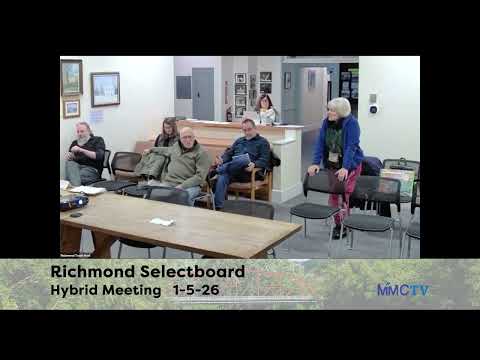
The Richmond Select Board on Jan. 5 heard the planning commission’s presentation of the draft 2026 town plan and a package of late amendments developed by the steering committee and public commenters. Planning‑commission chair Virginia Clark told the board the draft represents more than a rewrite: it incorporates new statutory guidance and mapping work done at the state and regional level.
Key additions: the amendment package strengthens language on equity (including food security actions, education access for multilingual and underserved students, and references to environmental justice under Act 154) and expands the natural‑resource chapter to explain forest blocks, high‑priority habitat and riparian protections. The commission overlaid state natural‑resource datasets on the municipal future‑land‑use map to identify priority areas for conservation; the commission emphasized the municipal map is informational, not a zoning map.
Residents raised mapping concerns: several speakers noted parcel boundaries on the state/regional base map do not match local tax parcels and worried about the consequences of coloring areas as 'conservation' in the future‑land‑use map. Planning staff and commissioners acknowledged the regional map is a broad‑scale snapshot and must be refined locally; they noted the process allows amendments and corrections and that any regulatory change would require separate zoning amendments.
Board action and schedule: The Select Board closed the first required public hearing and voted to direct the planning commission to insert the amendments into the draft and present a consolidated third draft at the required second public hearing on Jan. 21. That third draft will be the version presented to voters on town meeting day, pending regional approval and any final corrections.
Why it matters: The revisions reflect two central tensions facing Richmond and many Vermont towns—how to protect natural resources (including a state '30 by 30' target) while retaining reasonable opportunities for housing and local economic activity. The board and planning commission said the plan will be a platform to identify where detailed zoning or regulatory changes might be needed and to guide future policy decisions.
Clarifying details: The planning team reported 17 public meetings and a multi‑week comment period guiding the draft. Staff emphasized that the future‑land‑use map is not zoning and that parcel‑level corrections will be made where landowners identify inconsistencies. The planning commission plans to present the consolidated third draft for the Jan. 21 hearing and then proceed with the required warnings for the town meeting ballot if timelines remain intact.
What's next: The planning commission will prepare the third draft with inserted amendments, post it publicly, and hold the Jan. 21 hearing. The Select Board will review the final material ahead of the town meeting vote.