Get Full Government Meeting Transcripts, Videos, & Alerts Forever!
Get email alerts on the Stormwater Assessment topic
No spam. Unsubscribe anytime.
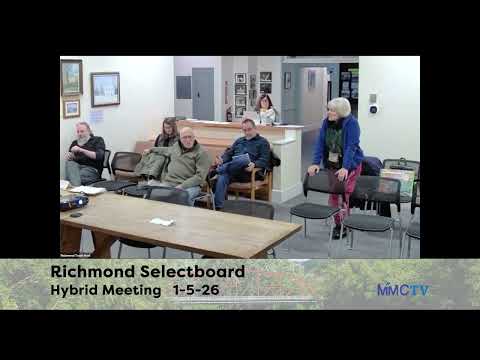
Richmond approves South View special‑assessment consent with $600,551 cap after long debate
Summary
After hours of public comment and board questioning, Richmond Select Board approved a consent form for a South View special assessment district to fund a state‑required 3‑acre stormwater project, setting a not‑to‑exceed total of $600,551 (including a 13.5% contingency) and a repayment term the board discussed with residents.
The Richmond Select Board on Jan. 5 approved a consent form that lets South View property owners form a special assessment district to construct stormwater improvements required by a Vermont 3‑acre permit. The board set the total not‑to‑exceed cost at $600,551, which includes a 13.5% contingency intended to cover design uncertainty and inflation.
The measure followed a lengthy public discussion in which residents pressed the board on equity, ongoing operating costs, the estimated construction price and the repayment term. Town staff presented a preliminary construction estimate of $310,000 prepared for early design; engineers cautioned the figure is preliminary and recommended a larger contingency until the project reaches 100% design. The draft consent form removes homeowners as co‑permittees and states the town will be the permittee if the district proceeds.
Residents at the meeting voiced two recurring concerns: first, that annual permit renewal and re‑certification fees and ongoing maintenance should be borne by the town rather than individual homeowners; and second, that the town should treat similar neighborhoods (for example Greystone and Hidden Pines) consistently. Several speakers, including South View residents, argued the town historically paid renewal and some maintenance costs for other neighborhoods and urged the board to do the same here.
Select Board members discussed several options for allocating costs. Staff noted certain permit fees and five‑year re‑certification expenses are statutory and are usually treated as district costs unless the board decides otherwise. Board members proposed covering the town’s administrative permit overhead (permit processing and renewal) while leaving operational maintenance as a district expense, though no automatic policy change for other neighborhoods was adopted at the meeting.
After discussion about contingency size and financing, the board adopted a motion to approve the consent form as amended and explicitly set a not‑to‑exceed figure of $600,551 with a 13.5% contingency. The motion passed by voice vote. The board and residents discussed a target repayment period and modeled examples for 10‑, 20‑ and 30‑year scenarios; participants settled on planning around a 20‑year repayment as a reasonable compromise for budgeting and to match available municipal financing options.
Town staff and residents outlined next steps: the town will mail consent packets to affected owners with a target turnaround date; the board set a goal of mailing by Jan. 9 and receiving responses by Jan. 20 to meet state grant timelines. Staff also said engineers will continue designs and that a formal county/state grant application and final bid‑ready plans will be required before construction.
What this means: If a sufficient number of property owners return signed consent forms, the town will proceed with final designs and bid the project. The approved not‑to‑exceed figure is the maximum that the consent will allow; the actual assessment will be reconciled to final invoices and grants. Residents and board members agreed to monitor costs and to revisit allocation of permit and maintenance costs in the future.
Clarifying details: The $600,551 figure includes a 13.5% contingency. Staff cited an initial engineering estimate of $310,000 for construction (preliminary). The town discussed borrowing options (e.g., state revolving loans with low administrative fees) and modeled a 20‑year repayment scenario that produced an estimated per‑parcel annual cost in the low hundreds (exact parcel calculations depend on final design and grant awards). The board asked staff to pursue grant opportunities and to present final figures before committing property owners to assessments.
Next steps: mailing of consent materials, return of signed consent forms, completion of 100% construction plans, grant application/submission and, if sufficient consent is received, moving to construction procurement. The board said it will present clearer, itemized figures to residents once the design is further advanced.