Get Full Government Meeting Transcripts, Videos, & Alerts Forever!
Get email alerts on the Utilities topic
No spam. Unsubscribe anytime.
Governor says new utility oversight will target affordability, points to H 1002 and a favorable AES rate recommendation
Summary
The governor said he has begun reshaping utility oversight to reduce household energy costs: a new utility counselor recommended a 10% cut in an AES rate request, three IURC commissioners were replaced with 'ratepayer conscious' members, and bill H 1002 would tie rates to affordability and reliability benchmarks.
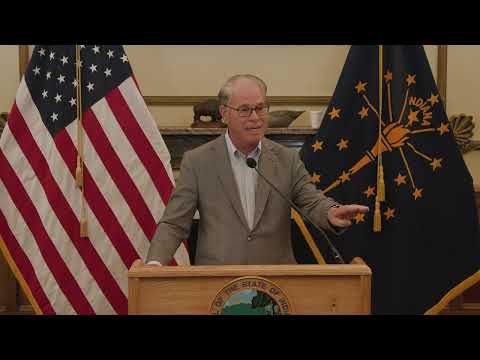
The governor said the state is launching a campaign to lower household utility costs by changing who oversees rates and by pressing utilities to deliver measurable savings.
He told reporters the administration appointed a new office of utility counselor who in her first major action saw an AES rate case in which the utility requested a 20% increase and she recommended a 10% decrease. "You're just starting to see what's happening with it," the governor said, adding that he and his team replaced three members of the Indiana Utility Regulatory Commission with what he called "ratepayer conscious individuals." He summarized the change in tone this way: "There's a new sheriff in town."
The governor linked the push on utilities to broader affordability goals, saying recent high inflation left households and governments burdened and that improving supply and regulatory incentives is a necessary tool to lower costs. He flagged agenda bill H 1002 as central to that effort, describing it as introducing performance-based ratemaking that would require utilities to meet benchmarks for affordability and reliability. "This is catching national attention," he said, and named the bill as part of a long-term strategy.
He also described recent voluntary measures by utilities aimed at short-term relief: he noted one company announced steps to provide relief, and said NIPSCO had waived late fees and reduced reconnect deposits for gas customers. "Trust and verify," he added when reporters asked how he would measure company commitments.
Data centers featured prominently in the governor's outline of implementation. He said companies seeking to site data centers in the state will be required to shoulder the costs they impose and ideally add generation capacity so they do not raise rates for other customers. "If you want to be a data center in this state, you're going to prove that if you come here, you're going to lower rates," he said. He also warned that permitting and state cooperation will be withheld where local water supplies are insufficient.
Why it matters: electricity bills and related utility charges are a monthly burden for many households, and tying regulatory oversight to affordability benchmarks could change what utilities invest in and how costs are allocated. The governor said H 1002 and administrative actions aim to shift decision-making power toward ratepayers and hold companies to measurable outcomes.
What happens next: H 1002 still needs legislative approval and the AES rate case will be resolved through regulatory proceedings. The governor said the administration is "just getting started" and promised continued pressure on utilities and oversight bodies to produce measurable consumer relief.