Get Full Government Meeting Transcripts, Videos, & Alerts Forever!
Get email alerts on the Water Infrastructure topic
No spam. Unsubscribe anytime.
Council reviews Bolton water-study and authorizes follow-up on regional and groundwater options
Summary
Councilors heard a draft water-system analysis from Bolton, which presented six alternatives with capital estimates ranging roughly $13M–$33M. The council authorized follow-up: questions for the East Range Water Board and a hydrogeologic study to evaluate groundwater as an alternative source.
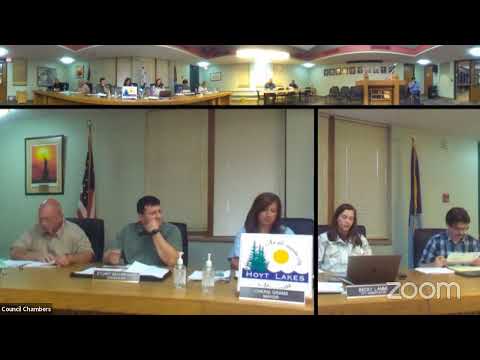
Hoyt Lakes city officials on Aug. 1 reviewed a draft water-system analysis prepared by Bolton and directed staff to pursue follow-up work on two alternatives: regionalization with the East Range Water Board and a hydrogeologic study to evaluate groundwater as a possible new source.
Jacob Chisco of Bolton summarized the report’s findings, saying the city’s source-water and treatment-plant age drive high operations-and-maintenance costs. He told councilors the study evaluated six alternatives — from restoring the existing treatment plant using the current lake source to building a new plant using groundwater — with capital estimates that ranged roughly between $13 million and $33 million depending on the option.
Chisco said Hoyt Lakes spends a large share of its budget treating lake source water and highlighted chemical and O&M cost differences: "your water production cost is roughly $3.9 per 1,000 gallons" and the city’s annual O&M range was presented at about $450,000–$530,000. He also noted the city’s chemical line-item of about $126,000 annually compared with an example community presented at $9,000.
Bolton’s technical-committee review narrowed the next steps to two priorities: prepare targeted questions to understand infrastructure ownership, representation and cost-sharing with the East Range Water Board, and commission a hydrogeologic (desktop and, if warranted, test-well) study to assess groundwater quantity and quality. Chisco said a desktop hydrogeologic study could take two to three months; full test-well programs would take longer.
Councilors discussed timing and the county’s road project that may require pipe-sizing decisions within months. After deliberation, the council moved and passed a motion to ask Bolton to begin the stated action items: draft questions for the water board, seek cost estimates for the interconnect option, and scope a hydrogeologic study to evaluate groundwater as an alternative.
Council materials include detailed cost-opinion tables and funding recommendations, including applying to the Drinking Water Revolving Fund for low-interest loans and reviewing affordability thresholds tied to state funding criteria.