Get Full Government Meeting Transcripts, Videos, & Alerts Forever!
Get email alerts on the Eviction Diversion topic
No spam. Unsubscribe anytime.
Housing authority reports rising evictions, urges more rapid rent-relief funding
Summary
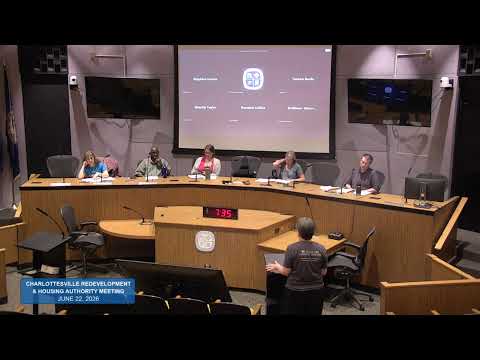
At a Charlottesville Redevelopment and Housing Authority meeting, staff presented eviction diversion data showing 94 participants since April and gaps in rapid rent-relief funds; commissioners and Legal Aid urged clearer thresholds, more outreach and transparency about court referrals.
Kathleen Glenn Matthews, the housing authority's grants and development coordinator, told the board the eviction diversion program (EDP) has enrolled 94 households in the recent reporting window and has recorded 143 family exits overall, with enrollment and exit patterns that often include repeat participants. "We've averaged about 25 people joining a month," she said, and added that program length varies by dataset ("our average time spent right now on our eviction diversion program is 68 days" while an AMP subset shows an average of 114 days).
Why it matters: Board members and advocates warned the agency's limited rapid rent-relief funding is constraining the program's ability to stabilize households and prevent repeat referrals to court. Staff said 67% of back rent reported in the AMP sample had been repaid, with an average repayment of $1,912 and a repayment range from $62 to $9,230.
Board discussion focused on policy thresholds and fairness. One commissioner asked whether the authority could adopt a practice that avoids court referrals for very small arrears, citing an example of $62. Deline, leading the discussion on policy constraints, cautioned that "we cannot pick and choose if someone owes $1,000 or $62" and warned that inconsistent application could expose the authority to liability. Staff described an existing hardship-exemption process and said it must follow HUD and statutory documentation rules.
Advocates and staff emphasized outreach and supportive services as central to reducing recidivism. Miss Banks, who works with resident services, urged broader outreach beyond staff referrals and said EDP covers non-rent barriers such as housekeeping and wellness. "Programs that combine rapid rent relief with ongoing supportive services yield the lowest recidivism rate," Kathleen Glenn Matthews said.
Legal Aid and FAR also weighed in during public comment. Emily Drifus, speaking for FAR and later wearing her Legal Aid Justice Center hat, urged the board to consider limiting court notices for small debts and to provide more transparency about vacancy rates and an ongoing lawsuit discussed in closed session. "If residents first is really the motto of this housing authority, then I think what Miss K said about being not fair for the housing authority is something to consider deeply," she said, urging the board to rethink automatic referrals for modest arrears.
What happened next: Staff said they are pursuing additional rental-relief funding, exploring third-party mediation partners to do direct outreach, and drafting a nonprofit entity to support diversion work (a separate update described nonprofit formation tasks). Board members requested clearer documentation of outreach touches and intake procedures so the authority can evaluate when and how households are referred to court. The board took no formal policy vote on thresholds during the meeting.
The meeting record shows the authority discussed the matter in closed session earlier and certified that the closed session conformed with the Virginia Freedom of Information Act.