Get Full Government Meeting Transcripts, Videos, & Alerts Forever!
Get email alerts on the Tax Expenditure Budget topic
No spam. Unsubscribe anytime.
Department of Revenue summarizes 2024 tax expenditure budget; highlights new incidence analyses and revenue-neutral metrics
Summary
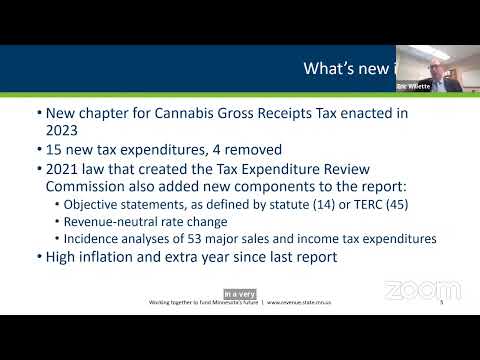
Eric Wlette of the Department of Revenue gave the commission a high-level overview of the 2024 tax expenditure budget, noting new chapters (cannabis gross receipts tax), 15 new tax expenditures, 53 incidence analyses and the addition of revenue-neutral rate calculations to frame the fiscal impact of tax preferences.
Eric Wlette, director of tax research at the Department of Revenue, told the Tax Expenditure Review Commission on Dec. 4 that the agency's 2024 tax expenditure budget catalogs the impact of more than 300 statutory provisions across 16 tax types and was completed on Nov. 1.
"The report provides an estimate of the impact of over 300 statutory provisions across 16 tax types," Wlette said, describing the document as a catalog of selective tax relief provisions that deviate from a uniform tax base. He said the 2024 edition is larger than prior editions largely because the report now includes objective statements, revenue-neutral rate calculations, and incidence analyses for a subset of major tax expenditures.
Wlette outlined three key additions in this edition: a new chapter covering the cannabis gross receipts tax enacted in 2023 (with four associated tax expenditures), a new revenue-neutral rate calculation showing how eliminating a tax expenditure could be offset by lowering tax rates to keep revenues neutral, and incidence analyses for 53 tax expenditures that break down benefit distribution across income deciles. He used the marriage credit and a child-and-working-family credit as examples to show how incidence can favor higher-earning or lower-earning taxpayers depending on credit design, and described the food-products sales tax exemption as an example of a largely uniform distribution where sales patterns are estimated from federal consumer-expenditure data.
Wlette cautioned that the report's dollar estimates are snapshots tied to a forecast and that numbers will differ from legislative revenue estimates because of timing, effective dates in proposed bills, and interactions between provisions. "When we do a revenue estimate, we take into account the specific language of that proposal," he said, noting interactions and timing can make an estimate differ from the tax-expenditure snapshot.
Commissioners asked technical questions about updating incidence analyses and the separate tax incident study; Wlette said the standalone tax incident study will be released in March 2026 and that incidence tables in the tax-expenditure budget are estimates based on available return data or federal survey data where necessary.
The presentation gave commissioners a framework for the commission's upcoming evaluative work: the tax-expenditure budget provides a baseline catalog and the commission will rely on that and on targeted evaluations to judge whether specific tax expenditures meet stated objectives.
Next steps: staff and commissioners said they will use the report and its new incidence analyses as a starting point for future evaluations and legislative review.