Get Full Government Meeting Transcripts, Videos, & Alerts Forever!
Get email alerts on the Animal Welfare topic
No spam. Unsubscribe anytime.
Lake County advisory board urges stronger adoption programs, facility upgrades and disaster planning in annual report
Summary
The Animal Care and Control Advisory Board presented its FY25–26 annual report to the Lake County Board of Supervisors, recommending expanded adoption and foster programs, facility improvements, fee reviews, pursuit of grant funding and new animal disaster-preparedness measures; supervisors agreed to receive and file the report.
Ryan Peterson, District 2 representative and secretary of the Lake County Animal Care and Control Advisory Board, presented the board’s fiscal year 25–26 annual report, summarizing findings and recommendations across seven priority areas: adoption programs, public education, facilities, fees and fiscal sustainability, animal welfare and enforcement, grant funding, and emergency preparedness.
The advisory board identified several cross-cutting challenges that undermine animal-welfare outcomes, including limited access to veterinary services, ongoing animal overpopulation, difficulty recruiting and retaining volunteers, low public awareness of available services, facility limitations, and reliance on short-term grant funding. “These challenges directly informed the recommendations,” Peterson said during the presentation.
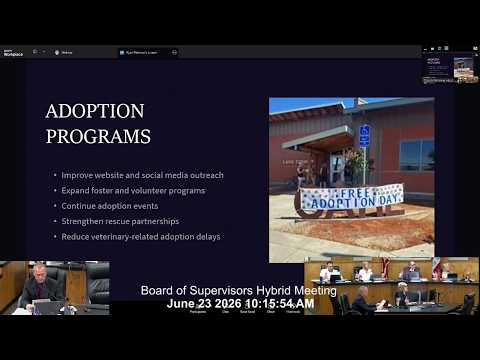
On adoptions, the board recommended modernizing online adoption resources, expanding social media outreach, developing foster and volunteer programs, continuing adoption events and strengthening partnerships with rescue organizations. The report said limited veterinary access lengthens adoption timelines and recommended exploring partnerships or funding to increase veterinary capacity.
The board recommended a year-round public education program focused on responsible pet ownership, vaccination and licensing compliance, spay-and-neuter services, disaster preparedness and youth engagement. The report urged enhanced digital communications and collaboration with community organizations to raise service awareness.
Regarding facilities, Peterson said the county shelter meets many operational needs but would benefit from upgrades: improved animal housing, larger medical and isolation areas, better adoption spaces and visitor accommodations, and dedicated volunteer training space. The advisory board recommended pursuing grant funding and partnerships to support capital improvements.
On fees and fiscal sustainability, the board recommended periodic review of fee schedules, benchmarking against neighboring jurisdictions and consideration of responsible-ownership incentives and targeted discounts when fiscally appropriate, with the stated aim of keeping services affordable while sustaining department operations.
The report also recommended continued evaluation of animal-welfare standards, expanded humane-care education and stronger collaboration among animal care and control, law enforcement and prosecutors. It highlighted successful grant-funded initiatives that support spay-and-neuter services, veterinary access and community-cat programs and recommended continued pursuit of state, federal and nonprofit funding with robust accountability and reporting.
Emergency preparedness was a prominent concern. The advisory board reviewed lessons from the county’s prior evacuation and animal-protection work and recommended developing a formal animal disaster-response program, strengthening regional partnerships and integrating animal evacuation planning into the county’s emergency-management activities.
A board member flagged AB478 (described in the transcript as “the found act”) and asked that county staff ensure Animal Care and Control is in compliance with any emergency-preparedness requirements in that law. The transcript indicated the bill was signed by the governor in January; the presentation did not include details of specific compliance steps.
Members discussed adding supervisors to the advisory board. A board member asked when a proposal to include supervisors would come forward; staff said the matter remains on the radar and they would check with county counsel and return with a request to assign one or two supervisors to the committee. Supervisor Kandle expressed support for adding supervisors to improve attendance and committee dynamics.
A member of the public thanked volunteers and committee members, praising progress while noting ongoing challenges with feral cats and unhoused dogs in the county.
The Board of Supervisors agreed to receive and file the advisory board’s annual report; the transcript records the chair saying the report will be received and filed and that future years will include updated annual reports whether or not a presentation occurs. The chair also praised Director Ray Smith for engaging with the advisory board.
What’s next: staff will follow up on the bylaw change to add supervisors (status to be checked with county counsel), review potential repurposing of LEAP-related funds mentioned during discussion, and assess compliance with AB478’s emergency-preparedness requirements. The board indicated it will receive an updated annual report annually going forward.