Get Full Government Meeting Transcripts, Videos, & Alerts Forever!
Get email alerts on the Solar Recycling topic
No spam. Unsubscribe anytime.
MassDEP workgroup hears industry on solar-panel recycling, policy options
Summary
MassDEP convened recyclers and industry on solar-panel end-of-life management, hearing that glass and adhesives are the primary technical hurdles, transportation and regional capacity drive costs, and policy levers under discussion include universal-waste designation, landfill bans, permit-based end-of-life plans and advanced-recycling fees.
Massachusetts Department of Environmental Protection staff convened a Recycling Market Development workgroup meeting to update a solar white paper and to hear industry perspectives on managing retired solar panels, batteries and related equipment.
Sean Sylver, of the MassDEP Commercial Waste Reduction Branch, framed the meeting as part of the state’s 10-year solid-waste master-plan work and noted the scale: research cited at the meeting estimates roughly 6,500 tons of retired solar panels in Massachusetts by 2030 and up to about 40,000 tons annually by 2050. Sylver said MassDEP will focus on recycling and market development rather than reducing solar deployment.
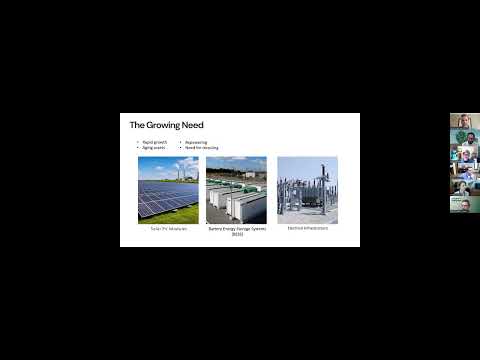
The session featured presentations from three recyclers. Londy Bracale, Business Development Manager at METech, described METech’s full-service approach—on-site field services, dismantling, palletizing and regional processing—and said the company documents each job in an online portal and pursues a zero-landfill commitment. Bracale emphasized the special handling required after fires or battery 'thermal runaway' events and said those incidents require environmental specialists and sampling before material movement. "These tanks that you see… Battery energy storage is on these sites because if we don't use the energy, the panels are producing, where's it go?" Bracale said, and added that damaged panels can change classification from universal to hazardous when caught in fires.
David (Dave) Hirschler, Chief Sustainability Officer of ERI, emphasized reuse testing, asset-level tracking and the regulatory landscape. He said the industry has seen limited success advancing full Extended Producer Responsibility (EPR) for solar and that some states are instead using permit or installation regulations that require end-of-life plans. On material challenges, Hirschler said "the glass is the biggest volume" and described the difficulty of separating laminated panel glass and adhesives—an obstacle to glass-to-glass recycling and a key technical constraint on domestic supply chains.
Brett Anderson, CEO and co-founder of SPR, outlined SPR’s multi‑million-panel capacity and technology investments and said the sector faces four primary end‑of‑life streams: manufacturer retirements, repower/tech upgrades, weather and operational damage, and construction breakage. Anderson gave cost ranges: incomplete or partial processing (for example, harvesting aluminum frames) can leave large portions stockpiled or landfilled, and "true" recycling—clean separation and recovery—was described during the meeting as roughly $8–$16 per panel, including transport, with transportation often the largest cost driver.
Presenters and attendees discussed policy tools. Several speakers advocated universal-waste designation (which can remove the need for individual hazardous-waste testing) and local landfill bans where recyclers are available; presenters also pointed to permit requirements that ask installers to include end-of-life plans as a rising regulatory approach. Panel producers such as First Solar were noted as operating their own takeback programs for cadmium-telluride panels, while other manufacturers and recyclers are piloting glass-to-glass remanufacturing at limited scale.
Municipal officials raised implementation concerns. Laurie Degnan of Charlton planning described a local decommissioning policy that requires bonds or cash sufficient to cover 100% of recycling costs and said towns struggle to track and enforce bonds when developers sell projects multiple times. Degnan said some surety bonds exclude contamination claims and that communities are seeking more reliable financial assurances.
Discussion at the meeting underscored two recurring themes: (1) technical barriers—particularly glass separation and adhesives—limit the range of domestic outlets for recycled panel material, and (2) logistics and regional capacity are crucial because transportation costs and consistent supply chains determine whether recovered materials find buyers. Presenters reported that recycling costs have been falling as technology and scale improve but that market demand for downstream materials—especially clean glass cullet—must grow to make domestic, closed-loop recycling viable.
MassDEP said it will use insights from the presentations and attendee feedback to update its solar white paper in 2026 and to continue workgroup discussions on regulatory options, market development and outreach to municipalities. The meeting closed with an invitation for follow-up engagement and data sharing between industry and state staff.