Get Full Government Meeting Transcripts, Videos, & Alerts Forever!
Get email alerts on the Referendum Polling topic
No spam. Unsubscribe anytime.
Poll shows majority support for property‑tax‑neutral funding tiers in Green Bay Area schools
Summary
A June district survey of 400 residents found broad favorable ratings for the Green Bay Area Public School District and majority support for two property‑tax‑neutral, four‑year levy scenarios (67% and 74% support in split samples); 29% remain firmly opposed and 41% are persuadable, the presenter said.
Peter, an outside pollster, presented June survey results of 400 district residents and told the school board the sample yields a margin of error of about ±5% and mirrors methodology used in February.
He reported that district perceptions remain positive: roughly 74–80% of respondents rate the quality of education highly and 74% say the district spends taxpayers’ money effectively and efficiently. On the question of a funding request, 29% were identified as core opponents to any district funding request while 41% were classified as persuadable.
Peter described two four‑year, non‑recurring, property‑tax‑neutral operating levy scenarios tested in the poll. In the first scenario (27M in 2027 rising to 50M in 2030), he reported 67% support and 30% opposed in that split sample. For a slightly different tiered proposal he reported 74% support and 23% opposed. Peter told the board that a key element driving support in the poll was the explicit statement that the levy would not increase property taxes.
The presenter also summarized constituency makeup and turnout variables: a typical respondent had lived in the district about 15 years, 26% reported having a child currently attending district schools, and geographic responses were roughly 70% Green Bay, 14% Bellevue and 12% Allouez. Peter cautioned that smaller subsamples reduce precision and that support can shift if a specific dollar amount or ballot language is used.
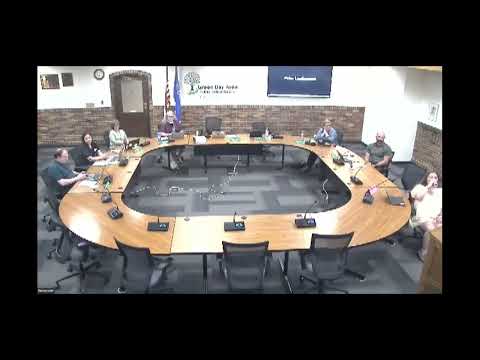
Board members asked for the slide deck to be made available and for a municipal break‑down; Peter said he would provide the slides and that collapsing cells was necessary for stable estimates. James said the board will take the results under advisement and that a work session in July will be used to craft any referendum question for a future ballot.
Quote: Peter said, "Simplicity is the best option moving forward with the funding requests to the public," urging clear, straightforward questions for voters.
Next steps: The board will review the poll at a July work session and, if it proceeds, must draft referendum language that aligns with legal constraints and what the district can commit to on the ballot.