Get Full Government Meeting Transcripts, Videos, & Alerts Forever!
Get email alerts on the Public Safety Drones topic
No spam. Unsubscribe anytime.
Lake County supervisors approve interior drones for sheriff after privacy questions
Summary
The Lake County Board of Supervisors approved a purchase of small interior unmanned aerial systems (SUAS) for the sheriffs office, up to $9,000, after supervisors and members of the public raised constitutional and data-retention concerns and the sheriff described use limits and exigency exceptions.
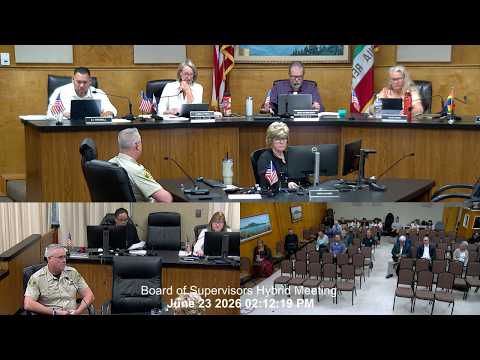
The Lake County Board of Supervisors voted to approve the use and purchase of small unmanned aerial systems (SUAS) for the Lake County Sheriffs Office in an amount not to exceed $9,000.
The purchase, pulled from the consent calendar by Supervisor Owen for discussion, prompted questions about privacy and legal limits after Owen cited an American Civil Liberties Union lawsuit in Sonoma County and a 1985 California Supreme Court ruling that restricts warrantless aerial surveillance of homes. "I just wanted your intake on . . . alleging warrantless drone programs, violations of the U.S. Constitution," Supervisor Owen said during the discussion.
Sheriff Bingham told the board the county already operates larger Matrice drones for investigative and search-and-rescue missions and that the small units under consideration are interior drones intended to be used inside residences by tactical teams to reduce risk to deputies. "These drones . . . are used for interior searches of residences. . . . We would not be sending the drone in there looking for evidence of a crime. If we were to fly drones over a residence to search for evidence, then we would absolutely have a search warrant," Sheriff Bingham said, describing the departments policy to seek warrants for evidence searches.
To justify warrantless interior flights in some situations, the sheriff cited exigent‑circumstances exceptions to the Fourth Amendment, such as a recent incident in Nice in which deputies sought to determine whether a potentially barricaded, armed subject was present without sending officers into a residence. The sheriff said relying on mutual‑aid from neighboring jurisdictions caused dangerous delays in that case.
Members of the public raised questions about tracking, marking, retention and access to drone video. "Are these drones equipped with GPS trackers for transparency . . . and are they marked with any identification?" asked Angela. The sheriff said flights are tracked but that the small units are not marked. Another commenter asked who would have access to retained video; the sheriff said evidence searches are kept as part of criminal investigations while search‑and‑rescue flights are typically not recorded or retained for any length of time, and that video access is internal or shared with partner law enforcement when part of a joint investigation.
Sheriff Bingham also said the SUAS purchase would be funded from the rural sheriffs fund, which is designated for equipment, not the county general fund. After discussion the board moved and seconded approval of the SUAS acquisition; the motion carried on a recorded 4-0 vote.
The board moved on to the next agenda item after the vote.