Get Full Government Meeting Transcripts, Videos, & Alerts Forever!
Get email alerts on the Behavioral Health Plan topic
No spam. Unsubscribe anytime.
Lake County approves final Behavioral Health Services Act plan; peers shifted from centers to outreach
Summary
The Board of Supervisors approved Lake County's integrated BHSA plan to align services with the state framework, prioritizing full-service partnerships, housing, and fidelity-monitored programs while phasing out peer-run wellness centers and promising targeted outreach and follow-up on data-harvesting concerns.
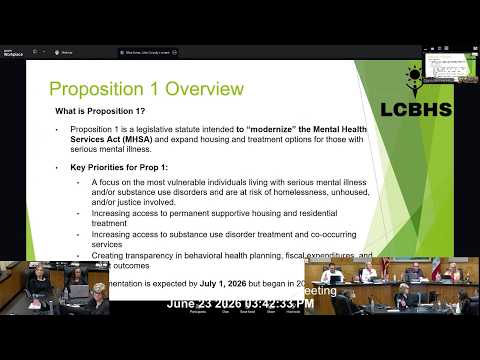
Elise Jones, Director of Behavioral Health for Lake County, told the Board of Supervisors that the integrated Behavioral Health Services Act plan "represents the final stage of approval" for the county's multi-year strategy to align local services with the state's BHSA framework. The board authorized submission of the plan to the state and directed staff to complete the required certification.
The plan implements changes required by Proposition 1 and Senate Bill 326 and restructures local allocations into three primary "buckets": 35% for full-service partnerships (FSP), 35% for behavioral health services and supports (BHSS), and 30% for housing. Jones said the county's estimated allocation for FY 2026-27 is $7.7 million, with approximately $1.9 million budgeted for FSP, about $4 million for BHSS, and roughly $1.88 million for housing interventions. She stressed that the BHSA narrows allowable program categories, which led to reductions in previously funded services that did not fit new buckets.
Why it matters: County staff said the FSP model prioritizes the most vulnerable residents with intensive supports aimed at preventing hospitalizations and incarcerations; Jones cited historical FSP outcomes showing dramatic reductions in both. The BHSA also requires enhanced public reporting and fidelity monitoring for evidence-based programs such as assertive community treatment, supported employment, high-fidelity wraparound, and coordinated specialty care for first-episode psychosis.
Not all prior programs could be preserved. Jones said peer-run wellness centers and some other programs were closed because they did not align with BHSA service definitions. She said the county will redeploy peer workers into clinical teams and expand outreach: "Our peers are now employed in part of our clinical team," and the department plans to send peers and mobile crisis teams into the community to maintain contact with people who used the centers.
Public commenters raised operational and privacy concerns. A community member identified as Angela asked whether lease end dates for closed peer centers could be released and pressed staff on "what is behavioral health doing to prevent harvesting of client information by third parties?" April Gamra, clinical deputy director, replied that the department has reported suspected misuse to the Department of Healthcare Services and asked residents to forward documents so staff could follow up.
Sabrina Andress, who leads Motherwise, sought clarity on continuation of prevention and early intervention (PEI) services such as perinatal screenings and nonclinical peer support, which her organization provides to hundreds of Lake County mothers. She said those services align with the county's stated goal of expanding outreach to underserved populations. Gamra and Jones said staff will coordinate with Public Health and community partners to determine how PEI functions will be sustained within the BHSA framework.
The board voted to authorize submission of the integrated plan and related certifications to the state. The director said the draft plan was filed by the March 31 deadline and the board's approval completes the county's local adoption requirement.
The board moved to the next agenda item after the vote; staff said detailed plan documentation is available on the department website.
Sources: Presentation and Q&A with Elise Jones and April Gamra; public comments by Angela and Sabrina Andress.