Get Full Government Meeting Transcripts, Videos, & Alerts Forever!
Get email alerts on the Cannabis Regulation topic
No spam. Unsubscribe anytime.
Lake County delays vote on revised commercial cannabis rules after questions on water, inspections and appeals
Summary
After staff outlined small edits and added environmental-analysis text to a draft ordinance amending Chapter 21, Article 27 of the Lake County Code, supervisors and multiple public commenters raised concerns about water oversight, inspection timing, background‑check appeals and the removal of a 10‑year permit term. The board voted to continue the item to July 7, 2026 for further revisions.
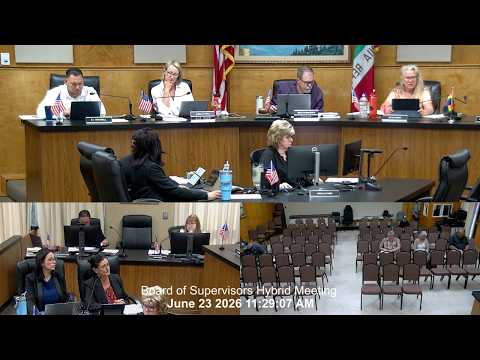
The Lake County Board of Supervisors continued public consideration of a proposed amendment to Chapter 21, Article 27 of the Lake County Code on commercial cannabis regulations after staff and members acknowledged outstanding technical and legal questions.
Community Development Director Miria Turner presented the draft ordinance in its fourth review and read proposed clarifying language for the environmental analysis. Turner said the "amendments modify the ordinance to increase restrictions. They do not propose, approve or fund any specific physical construction or ground disturbing activities," and she asked that County Counsel deem the added text nonsubstantive so the board could proceed with a first reading.
County Counsel advised the board that changes can be treated as substantive or non‑substantive but that the board may still proceed with a first reading; counsel recommended that any amendments the board intends to adopt be placed on the record in verbatim form or, alternatively, that the board continue the matter to a date certain for preparation of a revised draft.
Supervisors and members of the public raised several recurring concerns. One supervisor asked for stronger enforcement authority and questioned whether the $5,000 bond currently required for remediation is sufficient to abate abandoned grows and "hoop houses," citing constituent complaints about lingering sites. Staff replied that the ordinance retains a six‑month remediation requirement and remediation site visits and asked the public to notify the department when they observe abandoned farms.
Board members also sought clarification on several specific provisions: - Background checks: the draft limits checks to "full‑time employees" but does not define "full‑time." The board asked staff to add a clear definition (for example, a weekly‑hours threshold). - Permit term and vesting: staff said the draft removes the prior 10‑year term limit and corresponding renewal requirement and noted that the zoning code already provides a vesting mechanism (demonstrated investment) that prevents expiration. Several supervisors asked staff to identify prior meeting records that had directed removal of the term limit and to tighten criteria for what constitutes "sufficient vesting" so the provision cannot be gamed. - Inspection frequency wording: a clause uses the word "biannual," producing confusion about whether inspections mean twice per year or once every two years; staff agreed to replace ambiguous terms with explicit language ("twice a year" or "every other year"). - Water‑board enrollment/notice of applicability (NOA): staff and the director clarified that the NOA is required for activities that use water (notably outdoor cultivation) and that for activities that are not water‑intensive the application may include written verification from the regional/state water board that an NOA is not necessary; staff said it will clarify the page‑12 language. - Farmland Protection Zone (FPZ): members noted a map for FPZ exists (references to Ordinance 3101) but that the zoning code lacks a written definition of what qualifies as FPZ; staff will add a definition for consideration under Article 73.
Multiple public commenters echoed technical and due‑process concerns. Daniel Synum of the Lake County Farm Bureau asked to be reinstated on the county's review notice list for agricultural permits and urged consideration of FPZ expansion to shield farmland and reduce contamination risk. Attorney filings submitted on behalf of commenters were cited as arguing the proposed amendments are not exempt from the California Environmental Quality Act (CEQA), raising a procedural challenge about the need for environmental review. Lew Pillsbury of Family Farms urged the ordinance to include explicit procedures for applicants to challenge background‑check disqualifications, to submit evidence of rehabilitation or expungement, and to obtain written findings and appeal rights instead of relying on informal processes.
Tom Las, another commenter, told the board he was concerned the draft contains several material reductions — including vesting exceptions, narrowed background‑check scope, fewer automatic renewals, potential removal of NOA requirements for some operations, and exemptions for odor controls — and asked for clearer, specific language to avoid unintended loosening of safeguards.
After discussion, County Counsel recommended and several board members supported continuing the item to allow staff to draft precise language and to resolve outstanding procedural and technical questions. The board moved to continue the public hearing to July 7, 2026 at 1:30 p.m.; the chair called the motion and stated the motion "carries four zero." The continuance will allow staff to place any amendments on the record or prepare a revised draft for first reading and to add several follow‑up items to Article 73, including FPZ definition, Farm Bureau notifications, a full‑time definition for background checks, and clearer inspection‑frequency language.
What happens next: the matter returns on July 7, 2026 at 1:30 p.m. for further consideration; staff will supply clarified wording on NOA/ water‑board verification, explicit inspection timing, vesting criteria, and any amendments the board wishes to propose for a first reading.