Get Full Government Meeting Transcripts, Videos, & Alerts Forever!
Get email alerts on the Microgrid Feasibility topic
No spam. Unsubscribe anytime.
Lake County approves MIP agreements to fund feasibility work for 'Flashes' pumped‑storage microgrid
Summary
The Lake County Board of Supervisors approved agreements to accept Microgrid Incentive Program (MIP) grant funding and to authorize reimbursement agreements to begin up to two years of pre‑development and feasibility work for the 'Flashes' pumped‑storage microgrid; approvals fund studies only, not construction.
The Lake County Board of Supervisors on June 26 approved agreements that allow the county to accept Microgrid Incentive Program (MIP) grant funding and to sign reimbursement agreements to begin pre‑development work on the proposed ‘‘Flashes’’ pumped‑storage microgrid project, county staff said.
Deputy County Administrative Officer Ben Rickleman told the board the item authorizes grant agreements that would fund pre‑development and feasibility activities for the Hartley and Lucern projects—two collocated elements of the ‘‘Flashes’’ system—rather than approval of any construction. "This is grant funding for pre‑development, not project approval," Rickleman said, adding the work would include hydrology, geotechnical, environmental review and grid interconnection studies and that the pre‑development phase would take roughly two years.
Michael Day of Train, the county’s energy services contractor, said the design is a closed‑loop pumped‑storage system: two large tanks (one uphill, one near SR‑29) would move water through turbines to generate power; a solar array would provide energy to pump water back uphill. Day said the project is being structured to meet criteria in a prior Federal Energy Regulatory Commission decision (the Bison Peak guidance) that can avoid FERC jurisdiction in certain circumstances, but that hydrology and regulatory work are essential early steps. "We have to show that we are drawing water from outside of the hydro‑sphere," Day said, noting the hydrology study alone could cost about $500,000.
Staff and Train described two principal paths if the project proves feasible: an institutional developer could build and operate the facilities and lease county land, or the county could pursue ownership (potentially paired with revenue bonds). Cost estimates for full construction exceed $150 million, officials said, and potential county revenue from ownership is uncertain and would require further analysis.
Unions and workforce groups filled the public comment period in support of proceeding with feasibility work. Mark Mulliner of the California State Building and Construction Trades Council urged the board to negotiate a community workforce development agreement to secure local hiring and apprenticeship slots if the project advances. "It's not too early to start entering and negotiating a community workforce training agreement," Mulliner said, adding unions can help prepare local apprentices for construction jobs.
Other speakers praised the project’s potential for resilience and local jobs but raised concerns about transparency, dated cost estimates and environmental risk—particularly the potential for groundwater impacts if a leak occurred from partially submerged tanks. Staff said those risks are the purpose of the planned hydrology and environmental review work and that the MIP funding structure reduces near‑term county fiscal exposure because funds flow through the MIP and to contractor tasks.
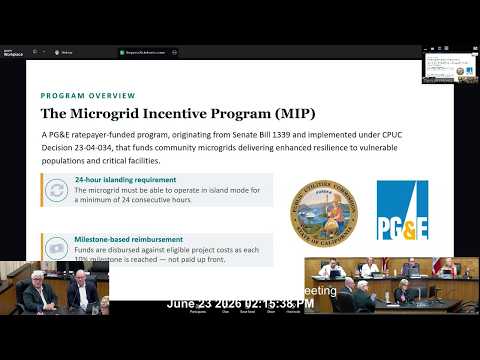
Rickleman said the MIP arrangements include a milestone reimbursement structure intended to leave the county cash‑ahead during pre‑development; Rural County Representatives of California (RCRC) offered a $200,000 0% interest loan to bridge cash flow during early stages. The board heard that Hidden Valley Lake, another MIP awardee, has already executed its PG&E agreement and begun analysis, which county staff said will speed contracting and onboarding for Lake County.
Two motions passed on unanimous roll calls recorded as "carries 4": first to approve the Microgrid Incentive Program agreements between PG&E and Lake County and authorize the chair to sign; second to approve the development reimbursement services agreements between Train and Lake County and authorize the chair to sign. The approvals authorize pre‑development and feasibility work only; any decision to build would return to the board following feasibility, permitting (including any EIR process) and policy discussions.
Next steps outlined by staff include executing the MIP and reimbursement agreements, initiating the hydrology and SQA (site‑specific regulatory) work, and returning to the board and the county’s ad hoc energy policy committee with updated cost estimates and policy options before any construction decision.