Get Full Government Meeting Transcripts, Videos, & Alerts Forever!
Get email alerts on the Municipal Budget And Taxation topic
No spam. Unsubscribe anytime.
Portsmouth council adopts higher tax classification for blighted properties, updates parking rules and approves behavioral health grant
Summary
The City Council approved an ordinance creating separate taxation classes for blighted and derelict properties, updated paid-parking rules for downtown while keeping weekends and holidays free, and accepted a $153,493.37 STEP Virginia behavioral health grant; all items passed unanimously.
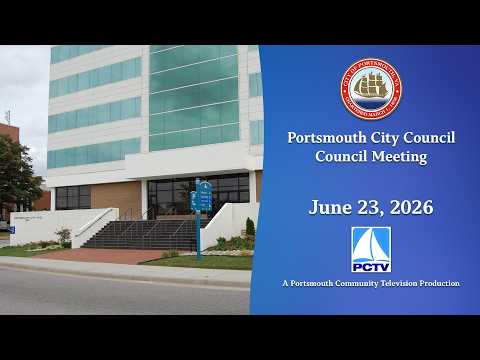
Portsmouth City Council on June 23 adopted a package of ordinances aimed at addressing neighborhood blight and updating downtown parking rules while approving routine consent items including a behavioral health grant.
The council voted unanimously to add a new classification in Chapter 35 of the city code establishing blighted properties and derelict buildings as separate classes for real-estate taxation. The ordinance sets a tax increase of 5 percentage points for properties the city defines as blighted and a 10 percentage-point increase for derelict buildings compared with the general real-property rate.
The vote followed public comment from David House, who told the council he has tracked condemned properties in the Simonstill area and said vacant and abandoned properties "have profound negative impacts on afflicted communities," including higher crime and lower property values. "Each neighborhood can be impacted by just one property and one blighted property or derelict property is one too many," House said.
Council members said the city already tracks properties that meet the ordinance definitions and pointed to other items on the agenda meant to give staff additional enforcement tools. Councilman Hugal said the rehabilitation-program amendments on the consent agenda are intended to assist enforcement and property rehabilitation efforts.
In a separate ordinance the council updated Chapter 22 and Appendix A of the city code to modify requirements and fees for on-street paid parking and parking in city lots and garages. Council members acknowledged social-media confusion about the policy and repeatedly emphasized that weekends, holidays and after-hours parking (after 6 p.m.) would remain free under the rewrite. "Weekends, holidays, after hours will remain free," Vice Mayor Moody said.
The council approved the consent agenda, which included amendments to the rehabilitated real-estate assessment credit program and acceptance of STEP Virginia peer-family recovery supports enhancement funding of $153,493.37 from the Virginia Department of Behavioral Health and Developmental Services, to be appropriated to the FY2026 behavioral health services fund. The clerk recorded the motions and all items were adopted by electronic vote (recorded in the record as 7-0).
The council also approved a slate of reappointments and new appointments to various boards and commissions, including the Board of Zoning Appeals, Planning Commission, Parks and Recreation Commission and others.
The ordinances and consent items are effective per the timelines listed in the city code; council members said staff would provide follow-up as necessary and that the updates to the rehabilitation program should help accelerate property improvements and enforcement where owners fail to complete required work.
The meeting moved on to other business and public comments following the votes.