Get Full Government Meeting Transcripts, Videos, & Alerts Forever!
Get email alerts on the Millage Split topic
No spam. Unsubscribe anytime.
Jasper County council weighs shifting fire/EMS millage split as budget gaps loom
Summary
At a budget workshop, Jasper County Council debated moving from an 80/20 fire/EMS allocation to a 50/50 split, with staff saying the choice could change millage rates and force roughly $4 million in cuts under one scenario. Council directed staff to prepare a 50/50 budget and reconvene.
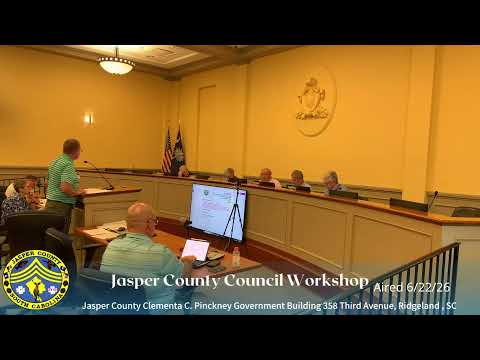
Jasper County Council members spent most of a budget workshop debating how to allocate millage for fire and emergency medical services, with competing scenarios — an 80/20 split previously presented and a newly modeled 50/50 split — producing materially different tax and spending outcomes.
Mr. Burgess opened the work session by telling the council staff had modeled the previously presented 115.5 millage under an 80/20 allocation and also prepared a 50/50 option. “Council asked us to take a look at a millage to 115.5 and we looked at that with an 80/20 for the fire millage. And then Council asked us to take a look at what it would be if we did a 50/50 for the fire millage,” he said, explaining staff had reallocated cost-of-living and departmental line items to show each scenario.
Why it matters: the split determines which taxpayers shoulder more of the cost. Staff showed that the change affects both the millage rate and total revenue available for county services. Kim Burgess, budget staff, told the council that recalculations put operating millage near 119.1 with a rural fire district rate of 23.5 under the 80/20 approach, and at 105.1 operating with a 58.5 fire district rate under 50/50; total modeled expenditures were about $78.37 million. “So that the unincorporated millage rate would be 147.6” under one approach and materially different under the other, she said.
Council members pressed staff on apparent arithmetic and allocation choices. One member noted the puzzling result that lowering the overall millage rate could sometimes show higher revenue in certain line items; staff attributed that to where cost-of-living and personnel costs had been shown —some previously as lump sums and now allocated to specific departments. Staff warned that some of the differences were timing- and allocation-driven and suggested the millage must be adjusted to align with the bottom-line dollar total.
Several council members expressed concern about the distributional effects on rural taxpayers. A councilor summarized the tradeoff: “If it’s 80/20, the urban taxpayer pays a little bit more. If it’s 50/50, the rural taxpayer pays a little bit more.” Another member said moving to 50/50 would require “roughly $4 million in cuts” from the presented requests, a figure staff identified as a reasonable order-of-magnitude impact under one scenario.
Councilors discussed compromise splits — 60/40, 65/35 or 70/30 — with arguments on both sides about whether call volume (which tends to be higher in municipal areas) or staffing and equipment cost allocation provides a better basis for the split. Fire and EMS stakeholders provide mixed signals: call-volume analysis supports one allocation while equipment/staffing considerations support another.
Outcome and next steps: rather than adopt a millage at the workshop, the council asked staff to prepare a working 50/50 budget and to return with additional data (including input from the treasurer and assessor on recent state changes such as homestead and boat/motor exemptions). A follow-up work session was scheduled for Wednesday at 3:00 p.m. for the council to review the revised numbers and consider cuts and millage adjustments.
The workshop produced clear direction but no formal vote on a final millage; council members said the next session should narrow choices after staff provides reconciled figures and the requested data.