Get Full Government Meeting Transcripts, Videos, & Alerts Forever!
Get email alerts on the Surveillance And Privacy topic
No spam. Unsubscribe anytime.
DeKalb council approves two-year Flock Safety ALPR contract after hours of public opposition
Summary
After more than an hour of public comment and council questions about privacy and oversight, DeKalb approved a two-year contract with Flock Safety for automatic license plate reader service not to exceed $27,500. Opponents warned of national data-sharing and civil-liberty risks; police and staff said the system enhances regional investigative reach and includes audit controls.
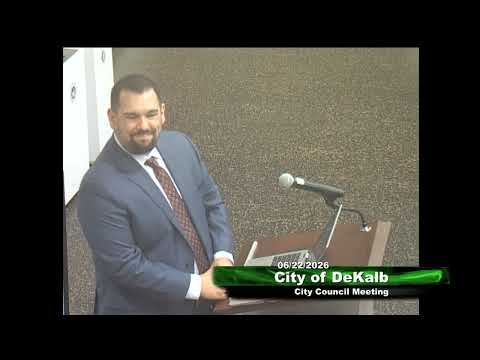
DeKalb’s City Council voted June 22 to approve Resolution 2026-059, authorizing a two-year contract (2026–2027) with Flock Safety for automatic license plate reader (ALPR) services in an amount not to exceed $27,500.
The decision followed an extended public-comment period and a lengthy staff discussion. Dozens of residents urged the council to reject the contract, saying Flock’s cloud-based network creates a national surveillance database that risks privacy and unequal enforcement. “This is a betrayal of the public trust,” a speaker identified in the record only as MA said, accusing the city of unaddressed discrimination toward Hispanic residents and urging criminal investigations. Elizabeth Johnson Cuney and Samantha McDavid cited recent news accounts and local examples where ALPR data had been misused and said the city should not feed local information into a national database.
Police and city staff defended the proposal as a targeted public-safety tool that will increase the department’s ability to locate vehicles connected to investigations. Chief Burwell said DeKalb already uses ALPRs and that the department requires a case number and written reason for each search. He told the council the city would retain ownership of LPR data, that the system’s regular search-audits flag anomalous use, and that policies prohibit federal access without the city’s permission. “Be righteous at all times,” the chief said, describing supervisory review and audit alerts designed to prevent misuse.
Supporters and police officials stressed technical differences between the city’s current provider and Flock. Staff said Genetec—the current system—connects roughly 20–25 agencies, while Flock’s network includes about 1,300 agencies in the region, giving broader real-time alerts when a vehicle enters DeKalb. Chief Burwell also said Flock picks up partial and temporary plates that the current vendor does not, and that the system’s 30-day evidence window is supplemented by permanent audit logs.
Opponents questioned those benefits, warned of the risk of data sharing with federal agencies and private brokers, and urged stronger public oversight: independent audits, clear data-retention limits, and publicly accessible transparency reports. Several residents referenced a widely reported case of a former Kansas police chief who resigned after alleged misuse of ALPR data; commenters said that history supports caution.
Council members debated the trade-offs. Alderwoman Larson and Alderman Carlson moved the measure forward; Alderman Walker voted no. The roll call as recorded in the meeting transcript showed a 4–1 tally in favor; the resolution passed.
Next steps are implementation of the contract terms, staff-confirmed settings that restrict federal access and immigration-related queries, and periodic reporting to the council. The transcript records multiple requests from members of the public for an independent public audit and an accessible transparency page documenting searches and administrative access.