Get Full Government Meeting Transcripts, Videos, & Alerts Forever!
Get email alerts on the Thompson Drain topic
No spam. Unsubscribe anytime.
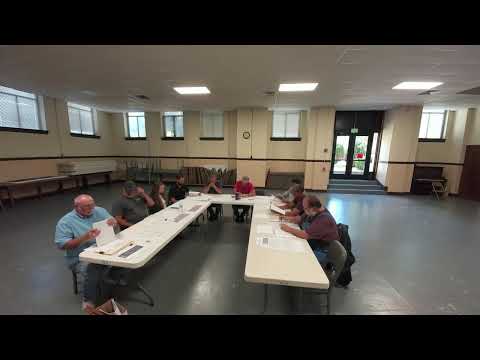
Drainage board adopts hybrid plan for Thompson regulated drain, seeks grants and hires consultant
Summary
The Vermillion County Drainage Board approved a hybrid reconstruction plan for the Thompson regulated drain (concrete at the outlet and county-road crossings, HDPE elsewhere), adopted planning assumptions (42-in main, ~30 laterals, 1.3 contingency) and voted to hire Martin Engineering (MEC) to pursue grant funding within the board’s professional services budget.
The Vermillion County Drainage Board approved a hybrid plan for reconstructing the Thompson regulated drain and authorized staff to pursue outside funding to pay for the work.
After an extended technical discussion about pipe materials, installation methods and long-term maintenance, the board voted to keep the 42-inch main where shown on the plans, install concrete through the outlet and the second 45-degree bend, and use HDPE (plastic) pipe elsewhere. The board recorded planning assumptions for budgeting: about 30 lateral connections and a 1.3 contingency multiplier on estimated costs. Staff presented an estimate for grant planning near $3,201,000 and emphasized that itemized line items (including lateral connection allowances) will be needed for grant applications.
The board also voted to hire MEC (Martin Engineering, Springfield, Ill.) to research and pursue grant funding and to prepare grant application materials within the limits of the board’s existing professional services budget. Staff told the board that federal programs consider local median income (LMI) and block-group boundaries when evaluating eligibility and that match requirements can be significant; one consultant suggested planning for a 25% match in some programs. Board members discussed possible local-match strategies including a county drainage fund, short-term loans, bonds, or assessments to landowners.
Board members debated the tradeoffs between concrete and HDPE: HDPE can reduce material and installation time but requires mandrel testing, camera inspection and engineered bedding; concrete is more robust under heavy road loading but raises material and installation costs. The board approved the hybrid approach so staff can finalize bid-ready documents and pursue grants; final pipe-size or dual-pipe alternatives will be modeled as nonbinding bid alternatives if the board desires.