Get Full Government Meeting Transcripts, Videos, & Alerts Forever!
Get email alerts on the Zoning Amendments topic
No spam. Unsubscribe anytime.
Jericho planning panel to remove separate 'rooming/boarding house' use, keeps PUD tied to major subdivisions
Summary
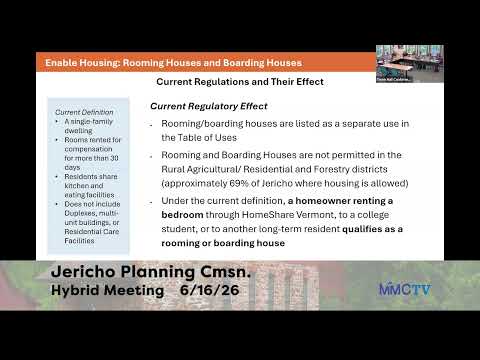
At its meeting, the Jericho Planning Commission recommended removing the separate zoning category for rooming and boarding houses — which staff said effectively bars rental rooms in about 69% of the town — and endorsed keeping planned-unit-development review tied to major subdivisions rather than to mapped natural-resource overlays.
Chris Shahin, the staff author of the draft zoning amendments, told the Planning Commission that his review found the current "rooming house or boarding house" definition is broad enough to include a homeowner renting a single room and that the classification is currently prohibited in the rural, agricultural and forestry districts. "...it effectively means rental rooms are not allowed in 69% of Jericho," he said.
Shahin recommended removing the boarding/rooming-house definition from the zoning code and from the table of uses, saying nearby towns take inconsistent approaches and the town lacks enforcement history tied to room rentals. "So, based on these findings, I'm recommending that we just remove the boarding house rooming house boarding house definition and remove it from our table of uses," he said.
The commission's discussion focused on whether a separate definition helps resolve disputes (for example, distinguishing a multi-unit building from a house with many rented rooms) and whether any numeric occupancy threshold would be defensible. Commissioners noted the town recently revised the household definition to remove numeric limits on unrelated people living as a single household, and several members said that change reduces the need for a separate rooming-house category.
On planned-unit developments, staff outlined two trigger options. Option A would require PUD review only when a set of criteria — including a mapped natural-resource-overlay (NRO) feature — are met; Option B would require PUD review for major subdivisions in certain zoning districts. Shahin recommended option B, arguing the district-based approach better advances PUD goals of preserving open space and clustering development in rural and low-density districts. Commissioners who spoke in favor said tying PUDs to the district made requirements clearer and more consistent than letting limited mapped features alone determine review.
Public commenter Jim said infrastructure limits — lack of municipal sewer, septic capacity, and emergency-access constraints on some roads — make many higher-density scenarios infeasible and urged the commission to favor "clean, simple" steps that can be implemented now. "If you want to see housing in Jericho, I suggest you adopt 'What is it that we can do now that is simple?'" he said.
Next steps outlined by staff include finalizing text amendments, completing legal review, and preparing for a planning commission hearing anticipated in September followed by a select-board hearing expected in October.