Get Full Government Meeting Transcripts, Videos, & Alerts Forever!
Get email alerts on the Land Use Temporary Use Permits topic
No spam. Unsubscribe anytime.
Sacramento County board upholds denial of El Fernito's temporary events permit after repeated noncompliance
Summary
The Planning Commission, acting as the Board of Zoning Appeals, denied an appeal and upheld the zoning administrator's refusal of a temporary use permit for El Fernito horse training facility at 13301 Renkyu Road in Galt, citing repeated failures to meet permit conditions, code-enforcement contacts and agency concerns. Commissioners discussed limited, conditional pathways for future events and a longer-term conditional use permit process.
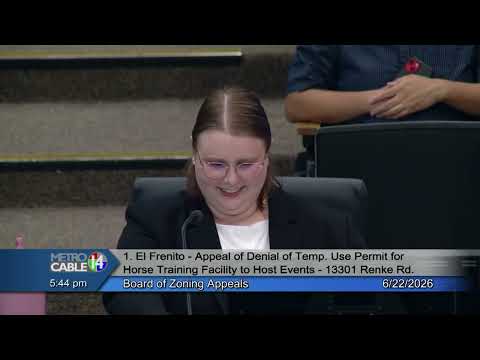
The Sacramento County Planning Commission, sitting as the Board of Zoning Appeals, on June 22 denied an appeal of a zoning administrator's decision and upheld the denial of a temporary use permit for El Fernito horse training facility at 13301 Renkyu Road in Galt.
Lead planner Regina Weiss told commissioners staff recommended denial after reviewing the applicant's record of prior permits and subsequent complaints. "I am here today to request the Planning Commission, acting as the Board of Zoning Appeals, deny the appeal upholding the Zoning Administrator's denial of the temporary use permit," Weiss said, summarizing planning's conclusion that the required findings for a temporary use permit could not be met.
Planning staff and code enforcement described a pattern of noncompliance: prior permits had placed limits on event dates, notification to the Sheriff's office and required business licensing for primary use. Staff said inspections and records showed events took place outside approved dates, that the county received repeated communications from the district attorney's office and the Board of Supervisors' office about neighbor complaints, and that Environmental Management Department records lacked evidence of required food-service permits. A code enforcement supervisor told the commission the office had mailed an initial notice in April 2025 and conducted six inspections and about a dozen documented contacts.
Commissioners also reviewed a Sacramento Sheriff's Office letter noting it found no crime reports tied to the location but expressing concern about the applicant's failure to provide required prior notifications; letters from the District Attorney's community prosecution office warned the property could constitute a public nuisance and referenced misdemeanor exposure, although staff said no criminal charges had been filed as of the hearing.
Applicant representatives said the owner and his family operate restaurants, that language barriers and a third-party intermediary had complicated past communications, and that the owner had paid fines and intended to comply going forward. David Avila, who said he was helping with permit filings, told the commission the owner "paid for those fines" and described the events as family-oriented horse training and occasional racing rather than large commercial festivals. Permit consultant Chris Trapp said he had been retained to pursue a permanent conditional use permit and asked commissioners to allow remaining dates for 2026 so his team could demonstrate compliance.
Commissioners weighed public-safety and neighborhood impacts against the applicant's assurances and the possibility of a longer-term solution. Several members expressed sympathy for language-access issues but said repeated failures to follow conditions and continuing complaints from neighbors and county agencies justified caution. Commissioners discussed alternatives including: denying the appeal (which generally bars reapplication for the same temporary permit type for one year under county code unless lifted by the Planning Commission or Board of Supervisors); granting a more limited temporary permit with strict conditions (fewer events, maximum attendance, parking and security plans, prior business-license approval); or encouraging the applicant to pursue a permanent conditional use permit (CUP), a lengthier process that would require Board of Supervisors approval.
After deliberation the commission voted to deny the appeal and uphold the zoning administrator's denial. Draft findings adopted by the commission cite the record of noncompliance with prior permit conditions, ongoing code enforcement actions and interagency concerns as grounds for the denial; commissioners edited the draft to add a sentence clarifying that the decision was not intended to be prejudicial to any future properly documented application for a temporary or permanent permit.
A denial leaves the owner with three principal paths described by staff: 1) obtain a business license and limit activity to the parcel's permitted commercial-stable/training use (no events), which would close the current code-enforcement case; 2) submit an application for a permanent conditional use permit and seek Board of Supervisors approval to authorize events beyond the temporary-permit caps (a process staff estimated could take about 10—12 months from a complete application); or 3) wait the one-year period associated with the denial before seeking the same temporary permit again (unless the Planning Commission or Board grants an exception).
The commission also asked staff to emphasize available language-assistance resources and to work with the applicant on technical details should the owner pursue a CUP or a narrowly tailored temporary allowance. The meeting closed after a brief scheduling note from county staff about July 13 procedural updates for public comment via Zoom.
What happens next: the denial stands as the official action of the Board of Zoning Appeals; the owner may pursue the pathways described above. Staff told commissioners a business-license application can often be processed within about 45 days after a complete submission and that a conditional use permit would require substantially more information and time.
Stakeholders and neighbors who wish to follow the case can contact the County Board Clerk at boardclerk@saccounty.gov or the Planning Department for instructions on future filings.