Get Full Government Meeting Transcripts, Videos, & Alerts Forever!
Get email alerts on the Reassessment And Growth topic
No spam. Unsubscribe anytime.
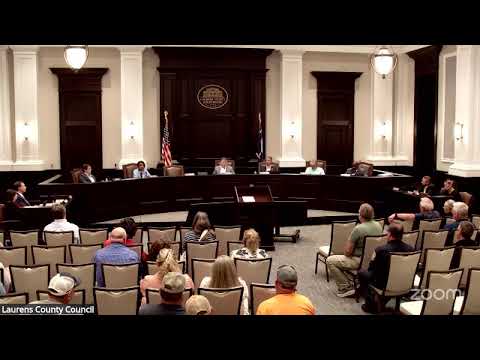
Residents press Laurens County on reassessment appeals, impact fees, roads, EMS and subdivision naming
Summary
At a crowded public input session following the special call meeting, residents criticized recent reassessment notices, urged stronger impact‑fee planning and road/EMS investments, raised questions about planning commission training records, and asked the county to help resolve a developer's planned use of a family name for a subdivision.
A large public input session after Laurens County’s special budgeting meeting drew sustained comment on the fallout from this year’s countywide reassessment and on growth‑related impacts on roads, emergency services and community character.
Reassessment and appeals: Multiple residents called the reassessment notices a financial shock for long‑term homeowners and asked how values were calculated and how to appeal. Laurens County assessor GW (referred to in the meeting as GW Daily) explained the mass‑appraisal process used in a five‑year reassessment cycle, said staff divided the county into 58 appraisal areas and visited "well over 20,000" properties in person, and described statutory caps limiting taxable increases. GW urged residents who believe their value is incorrect to appeal in writing before the Sept. 8 deadline and said evidence such as comparable sales, bank appraisals or documentation of destroyed structures can affect results: "If you think it's wrong, please send a letter with the value you think is current... we'll respond to everyone," GW said.
Impact fees and new construction revenues: Residents and some council members pointed to roughly $300–$350 million in new construction that is taxed in arrears and noted the county is studying impact fees; staff said an initial draft of the impact‑fee study is expected within months and a final report in roughly three to four months. Several public speakers urged the county to adopt impact fees so new development covers its share of infrastructure costs rather than placing that burden on long‑term residents.
Roads, EMS and local services: Speakers in multiple districts described unpaved or narrow county roads that they said impede emergency response. One resident asked why roads that have been paid for via taxes are not maintained and requested county follow‑up. Council members acknowledged the concerns and invited impacted residents to provide addresses so staff can investigate and report back.
Planning commission training and transparency: Joseph Kohler said a FOIA request for records proving planning commission training compliance with S.C. Code §6‑29‑1340 was met with a reply that no such records were maintained; he asked council to explain how they verify training compliance and to take corrective steps if records cannot be produced.
Subdivision naming dispute: Ashley Riddle told council that a proposed subdivision by a developer identified as Crown Developers had applied to use the name "Riddle Farm," a family name her family has used for decades and for which she said the family holds trademark and common‑law rights. County officials said their practice is to check only for duplicate subdivision names in county records; the county attorney, Mr. West, said trademark disputes are private civil matters but that he had asked the developer to change the name.
Data centers, environmental and health concerns: Several residents urged the county to adopt a moratorium or study on data centers, citing water use, air and noise impacts and uncertain local benefit. Council members said they would consider the concerns, but no moratorium was adopted at the meeting.
Follow‑up and next steps: County administrators committed to: (1) provide clear instructions and follow‑up to residents on reassessment appeals and evidence that helps appeals; (2) complete the impact‑fee study in the coming months and report findings; (3) investigate specific road and EMS access complaints provided by residents; and (4) continue to advise residents that trademark disputes over subdivision names are private matters but that staff will attempt to mediate when possible.