Get Full Government Meeting Transcripts, Videos, & Alerts Forever!
Get email alerts on the Fire Rescue Audit topic
No spam. Unsubscribe anytime.
Audit finds gaps in fiscal controls at Montgomery County Fire & Rescue; EMST distributions lack documentation
Summary
The inspector general’s performance audit found missing supporting documentation for many EMST‑funded projects, inconsistent procurement practices among volunteer fire and rescue departments, and deficiencies in p‑card and travel approvals; Fire & Rescue leaders said they are developing policies, training and systems to address the findings.
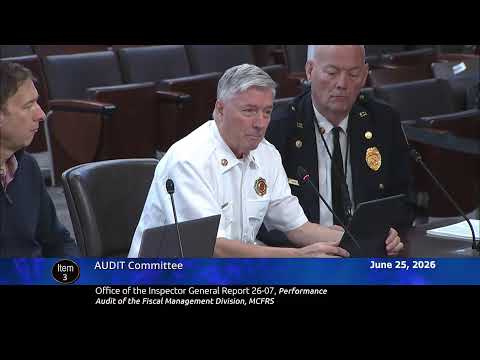
The Office of the Inspector General presented a performance audit of fiscal management at Montgomery County Fire and Rescue that found incomplete documentation for EMST‑funded projects, inconsistent procurement practices at local volunteer fire and rescue departments (LFRDs), and weaknesses in purchasing‑card and travel approvals.
"We tested 40 different projects that are valued at about $1,200,000, and we found numerous issues with the projects," Inspector General Marcy Lamarzi said. "In eight of those projects we found no evidence of supporting documentation…32% of what we looked at had insufficient support…and 80% of the sample showed that they were missing these timelines." The IG described four findings and seven recommendations; six recommendations remain open.
Scope and key findings: The audit focused on the fiscal management division and oversight of distributions from the Emergency Medical Services Transport (EMST) reimbursement program, which pays out funds to the county’s 19 LFRDs. Auditors found that 21% of sampled projects used invoices instead of formal contracts and only 14% complied with bid requirements where applicable. The report also noted inconsistent tracking of encumbrances and reporting, and cited instances where LFRDs had broad latitude to reallocate funds contrary to agreements.
Fire department response and planned fixes: Fire Chief Corey Smetley said the department has convened a working team with fiscal management staff and the volunteer association, begun updating policies and is pursuing better automation and training. "We've had about five meetings thus far to not only update the policy with the additional recommendations, but some of these things…are process challenges that are not as efficient as they can be," the chief said. Division chief Dominic Del Pozo said the department will require quarterly reports, contracts, invoices, bank statements and canceled checks and will codify procurement thresholds (oral quotes under $3,000, three written bids over $3,000).
Volunteer services perspective: Michael Kelly, division chief of volunteer services and a former association funding manager, described an "education factor" in bringing 19 distinct volunteer organizations to consistent practice and said much of the EMST funding has been used for facilities and apparatus. He and department officials emphasized training for volunteer treasurers and leaders as a central element of corrective action.
Other control issues: The OIG flagged purchasing‑card transactions with missing prior approvals and miscoded expenditures, system errors that required correction, and travel transactions that had not been entered into the county’s eTravel system; auditors warned these lapses expose the county to risk of unallowable spending or fraud.
Follow‑up and oversight: The CAO agreed with the audit’s recommendation to require financial audits of EMST distributions and has assigned the internal audit manager to begin those reviews. Fire and Rescue said it will continue policy revisions, training, system updates and compilation of documentation to support EMST projects. Committee members praised volunteers and career staff and asked for timely notification when serious issues are identified.
The committee heard no formal vote; auditors and department staff said they will continue to work on the open recommendations and that the CAO’s office will staff the next phase of financial audits.