Get Full Government Meeting Transcripts, Videos, & Alerts Forever!
Get email alerts on the Open Government topic
No spam. Unsubscribe anytime.
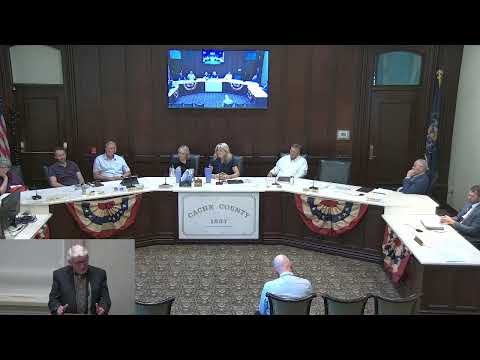
Council adopts ordinance to codify remote participation rules, requires 24‑hour notice and anchor‑location quorum
Summary
Cache County adopted Ordinance 2026‑27, consolidating electronic meeting procedures into county code, establishing the historic courthouse as the anchor location, preserving board authority to approve remote participation, requiring a separate 24‑hour notice for electronic meetings and authorizing the chair to waive anchor-location during declared emergencies.
Cache County Council voted to adopt Ordinance 2026‑27 to consolidate and clarify the county’s electronic meeting procedures under chapter 2.16 of county code.
Andrew (staff) explained that the ordinance places electronic‑meeting rules next to other council meeting procedures so local officials have a single reference for how remote participation should operate under the Utah Open and Public Meetings Act (as amended by HB502). The ordinance requires a physical quorum at the Cache County Historic Courthouse as the anchor location before remote participation is approved by majority vote, grants remote participants full voting rights after approval, and requires a separate 24‑hour public notice if a meeting is designated as an electronic meeting.
The ordinance also provides emergency authority: during a declared health or safety emergency the council chair may waive the anchor‑location requirement through a written determination, and the county executive’s declaration of a temporary seat of government may be used as an anchor location if needed. Councilors asked clarifying questions about whether votes to allow remote attendance may occur at the start of the same meeting, whether the public must be given remote participation access for public hearings, and what security measures would be required for remote participants; staff said notice and vote procedures are separable and security practices use the county’s existing streaming tools.
After discussion and a motion to suspend the rules and adopt the ordinance, the council passed Ordinance 2026‑27. A single councilor voiced a recorded 'Nay' during the roll call sequence recorded in the meeting; staff noted the ordinance had been vetted through the county’s open‑meetings review process.
What happens next: the ordinance places the county’s electronic‑meeting policy into code; staff will implement notice protocols and draft any operational guidance (e.g., recommended security or video requirements) as needed.