Get Full Government Meeting Transcripts, Videos, & Alerts Forever!
Get email alerts on the Water Supply topic
No spam. Unsubscribe anytime.
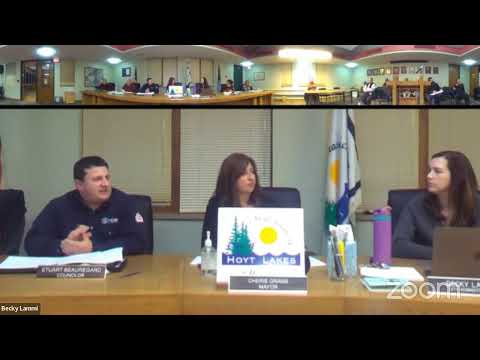
Hoyt Lakes council authorizes meetings with East Range Water Board after hearing groundwater study options
Summary
After a consultant presented a three‑phase groundwater assessment and compared costs with joining the East Range Water Board, the Hoyt Lakes City Council voted to pursue meetings with the water board and appointed council representatives to get detailed cost‑sharing and operational answers.
An engineer presented a three‑phase groundwater assessment and water‑supply proposal to the Hoyt Lakes City Council on Nov. 25 and recommended further study before committing to a municipal well program. The council then voted to meet with the East Range Water Board to explore regionalization as an alternative.
The presenter outlined Phase 1 as a preliminary engineering and record search to identify prior studies and land-access issues; he said the phase would take “two to three weeks” and estimated the upfront work at about $8,000. He also described Phase 2 as a desktop hydrologic evaluation, estimated at roughly $30,000 and expected to take two to three months, and Phase 3 as in‑field test wells and pump testing, with an illustrative cost of about $100,000 per test well and a timeline extending into mid‑summer if started Jan. 27. The presenter also stated, later in the discussion, that the bundled proposal for initial assessments appears as $88,000 in the document; the transcript contained both $8,000 and $88,000 figures, and staff was asked to clarify the discrepancy.
On regional options, the presenter said the East Range Water Board is likely to be cheaper over the long run because economies of scale would reduce operations and maintenance costs. “The East Range Water Board would be cheaper since the O&M and repair costs are ultimately shared,” the Engineer said. He and consultants also explained how the Public Facilities Authority (PFA) affordability framework works and how grant caps affect borrowing and grant eligibility.
Council members asked technical and practical questions: whether homeowners could provide voluntary well samples (the presenter said homeowners may test their wells but that homeowner sampling is not a substitute for municipal testing), where earlier well data had been filed (state records and earlier studies), and whether the city could rely on Aurora or the East Range board to upsize mainline infrastructure on Highway 110 to enable a connection.
Council member Dave moved that Hoyt Lakes proceed with meetings with the East Range Water Board and appoint Jake and a council representative to participate; the motion was seconded and carried. The council asked the appointees to seek specific answers on cost‑sharing, jurisdictional vs. shared infrastructure, employee arrangements and the ownership cut‑off point for any new pipelines or facilities, and to report back with concrete options.
The council did not authorize immediate construction or well testing at the meeting; instead members directed staff and the appointed representatives to obtain more detailed engineering cost splits and governance language and return to council for a decision.
Next steps: Hoyt Lakes staff will clarify proposal costs (the $8,000 vs. $88,000 discrepancy in the document), obtain more detailed cost‑sharing formulas from engineers, and report back to council with options for a formal agreement or a recommendation to proceed with a municipal well program.