Get Full Government Meeting Transcripts, Videos, & Alerts Forever!
Get email alerts on the Pension Reform topic
No spam. Unsubscribe anytime.
LCPR members weigh pension trade-offs: retirement age, multiplier, past‑service credit and who pays
Summary
Commission staff presented actuarial cost menus showing a baseline first‑year employer cost of about 19.1% and multiple scenarios; members pressed over whether past‑service credit would be included, how retirement age and multipliers change costs, and whether employees will accept higher contributions.
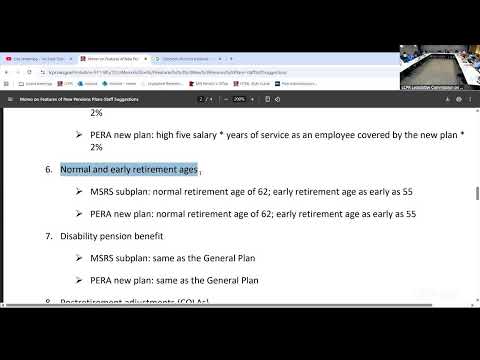
LCPR staff presented a grid of actuarial scenarios for a proposed new pension plan and an MSRS subplan, showing a baseline first‑year employer cost of roughly 19.1% under the initial assumptions. The staffer explained the grid lets the commission see how changing a benefit multiplier and post‑retirement annual increases (COLA) alters the initial cost estimate.
The actuary explained that the ‘‘annual increase assumption’’ in the charts is the post‑retirement COLA; because the actuary runs thousands of stochastic scenarios, the firm reports a single equivalent percentage (for example, 1.5% for the general plan under its formula). Participants asked for clarity about how that assumption maps to fixed‑rate equivalents and how changes to the normal retirement age (for example, 62 vs. 60) would require new, explicit runs by the actuary.
Several commissioners pressed staff about past service credit. Multiple participants noted that an earlier bill taken to the legislature included past service credit but that staff’s current menu omits that feature. Susan (LCPR staff, executive director) clarified PAR did not cost a scenario that grants credit for all past service across the board; stakeholder groups had obtained separate cost estimates. Commissioners said the distributional question — “who benefits and who pays” — is central: two plans with similar headline costs can deliver very different outcomes across cohorts depending on whether past service is bought forward or whether costs are spread over future hires.
The commission discussed intergenerational equity at length. Members flagged that raising benefits for those close to retirement can increase the burden on hires and newer employees and that distributional trade‑offs matter to legislators. Joel Matthews recounted past debates (2010 omnibus changes, a 2017 bill that was vetoed after affecting only one group) to illustrate how those political trade‑offs have unfolded historically.
On plan design trade‑offs, staff explained why a higher multiplier may be required if the commission wants an earlier unreduced retirement age (for example, moving from 62 to 60 typically requires a larger multiplier to preserve similar retirement income replacement ratios). Commissioners asked staff to prepare alternative bill packages — a low‑cost set, a generous set and a middle ground — to present to the legislature rather than a single, binary option.
A key political constraint surfaced on funding: employer representatives indicated that employers are unlikely to pay substantially more than current general plan rates, so any additional benefit would likely require higher employee contributions or a one‑time appropriation. Representatives speaking for employee groups indicated members generally oppose large payroll deductions; one employer‑side representative said members were unlikely to accept more than an additional 2% employee contribution. Staff reiterated they will calculate total costs for chosen features and then propose splits between employer and employee.
Staff told the commission they need decisions on core ‘‘ingredients’’ (normal retirement age, multiplier, COLA design, vesting) soon to allow LCPR staff time to draft one or more bills before session. The commission scheduled a follow‑up meeting for October 20 and discussed holding a longer work session to resolve the funding question and finalize the features to send to the actuary for any additional runs.
Ending: The commission did not take formal votes. Staff will prepare comparative cost runs and draft bill language (including one or more alternatives) for commission review at the next meeting.