Get Full Government Meeting Transcripts, Videos, & Alerts Forever!
Get email alerts on the 30 Parade Hill Denial topic
No spam. Unsubscribe anytime.
Planning commission denies 14-unit Parade Hill project, finds proposal does not qualify as 'assisted housing' under state statute
Summary
The commission voted unanimously to deny the 30 Parade Hill site-plan application, concluding that the applicant's sales-tax exemption and voucher arrangements did not amount to demonstrable, binding governmental financial assistance required to exempt a project from the local moratorium under CGS 8-30g; the resolution cites lack of binding voucher commitments and non-binding memoranda of understanding.
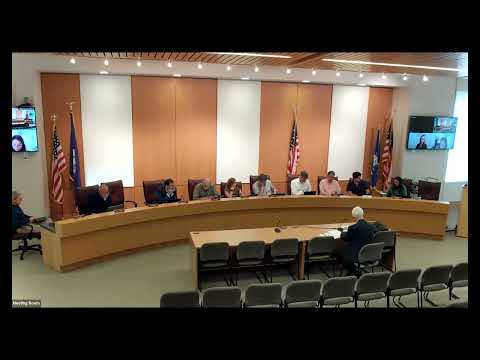
The New Canaan Planning & Zoning Commission on June 23 adopted a denial resolution for a 14-unit site-plan application at 30 Parade Hill Road after concluding the project did not qualify as "assisted housing" under Connecticut General Statutes 8-30g(a)(3).
The applicant, GHF Parade Hill Road LLC (Garden Homes Fund) represented by attorney Amy E. Suchins, sought approval to construct a three-story, 14-unit building on a 0.37-acre parcel split between the B residence and half-acre zones. Staff summarized that the proposal included 16 parking spaces (where 28 would be required by zoning), a building footprint of 3,868 square feet (exceeding the town's footprint limit for the lot), and a maximum building height of about 38 feet, nine inches — exceeding standards in the underlying zones.
A core question before the commission was whether the project qualified for the moratorium exemption in CGS 8-30g(L)(2) for "assisted housing." The applicant offered two affordability scenarios: an alternate plan that would deed-restrict all 14 units (with five units targeted for voucher holders and deed restrictions in perpetuity) and a default plan with 11 affordable units. The applicant also submitted a Department of Revenue Services (DRS) Reg. 19 application for a sales-and-use-tax exemption and an executed memorandum of understanding with the Housing Collective describing voucher coordination.
After reviewing the record (including the DRS reg 19 application, letters from voucher administrators, a state contract with the Housing Collective, the MOU between Garden Homes Fund and the Housing Collective, and legislative history from the 2000 House bill that created the exemption), the commission found that: (1) governmental financial assistance sufficient to meet CGS 8-30g(a)(3) must be demonstrable and tied to the project by binding commitments, enforceable affordability obligations, or ongoing governmental oversight; (2) the DRS sales-and-use tax exemption does not transfer funds to the project nor create an ongoing funding relationship; and (3) tenant-based vouchers "follow the family" and cannot be irrevocably committed to a building prior to occupancy, and the Housing Collective is not an authorized voucher administrator for New Canaan.
The commission concluded that any claimed governmental assistance extended to at most five of the 14 units, so the development did not satisfy the assisted-housing definition. Commissioners debated and removed language that would have stated oversight is always required, leaving findings tied strictly to the record. On a recorded roll-call vote the commission adopted the denial resolution (motion to deny moved by "Commissioner Chris"; second recorded; roll call recorded unanimous yes votes), formally denying the application and confirming the town's active certificate for affordable housing completion remains in effect through August 27, 2028.
Evidence and key quotes: During questioning at the May 26 public hearing, Garden Homes Fund's representative, Richard Friedman, said the project could be built entirely with vouchers but expressed policy reservations — "I could build it. Sure. I think it would be poor public policy, and that is not how I would want to see this building occupied with tenants." Commissioners emphasized that the applicant's submitted MOU and letters were not binding commitments from a governmental agency capable of guaranteeing vouchers.
What this means: Because the commission found the development did not meet the statutory assisted-housing threshold and the moratorium exemption did not apply, the application remains subject to local zoning and was denied on that basis. The denial was limited to the record before the commission and tied to statutory interpretation and evidentiary findings recorded in the resolution.
Next steps: The denial resolution was adopted on the record and will be posted with the commission's minutes. The applicant may appeal or revise and resubmit; the commission said it reviewed the matter based solely on materials in the record and statutory standards under CGS 8-30g.