Get Full Government Meeting Transcripts, Videos, & Alerts Forever!
Get email alerts on the Tax Policy topic
No spam. Unsubscribe anytime.
Association of Indiana Counties briefs Monroe Council on sweeping property‑tax and LIT reforms
Summary
Jamie Polser of the Association of Indiana Counties told the Council how recent state laws phase out the homestead standard deduction, convert several deductions into credits, change circuit‑breaker treatment and reshape local income tax (LIT) distribution — including a new stacked LIT structure — and urged a cautious, data‑driven local response, including convening a MUST meeting before 2029.
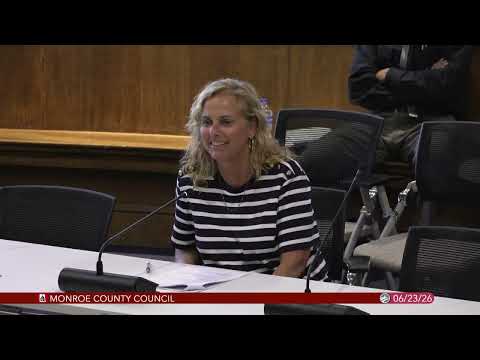
The Monroe County Council received a technical briefing on state tax changes and local impacts from Jamie Polser, director of government affairs at the Association of Indiana Counties, who spent more than an hour explaining changes that take effect over the coming years.
Polser walked council members through Senate Enrolled Act 1 and related bills that phase out the homestead standard deduction and phase in a homestead supplemental deduction calculated as a share of assessed value. She warned the shift will reduce some homeowners’ liability while creating disproportionate impacts for higher‑valued properties and for non‑homestead residential categories. She also explained a new 2% circuit‑breaker bucket that will cover many non‑homestead residential, rental and agricultural properties and stressed that converting deductions to credits produces a dollar‑for‑dollar revenue loss for local units.
A central part of the presentation addressed local income tax (LIT) reform and the MUST (municipal unit strategic task force) process. Polser described the new stacked LIT structure that separates a county service rate, a fire/EMS rate and small/large municipal options; she explained how municipal opt‑in/opt‑out choices, population thresholds and allocation procedures will affect local distributions and warned councils to gather detailed debt and AGI data before negotiating MUST agreements.
Council members asked numerous implementation questions about how the new structure will affect county revenue, small municipalities, and allocation of debt-related levies. Polser recommended a cautious, data‑driven approach and offered the AIC’s interactive LIT portal for modeling county choices.
Next steps: Council liaisons and staff were encouraged to use the AIC tools, collect certified net levies and municipal AGI, and begin planning for possible MUST discussions ahead of the 2029 implementation date.
Sources: Monroe County Council meeting transcript, June 23, 2026.