Get Full Government Meeting Transcripts, Videos, & Alerts Forever!
Get email alerts on the School Budget topic
No spam. Unsubscribe anytime.
Northville Public Schools projects $4.5 million deficit in initial 2026–27 budget
Summary
At a June budget hearing, district staff projected a $4.5 million structural deficit for 2026–27 driven by higher salaries/benefits and an enrollment decline; officials budgeted a $250 per‑pupil state aid increase but said final figures depend on the state budget.
Northville Public Schools officials presented an initial 2026–27 budget at a public hearing, projecting a $4.5 million structural deficit and an expected fund balance around 24% if current assumptions hold. Mr. Kling, who led the presentation, told the board the district is including a $250 per‑pupil increase in state aid in its baseline despite ongoing uncertainty in the state budget.
The presentation explained the district’s revenue assumptions and local tax structure. Mr. Kling said non‑PRE (non‑homestead) property tax revenue tied to the district’s 18‑mill levy is expected to yield "over $11 million dollars" for the general fund next year. He also noted 3.4 mills earmarked for debt service and a 0.9284‑mill sinking fund levy for technology and capital outlay.
On enrollment, Mr. Kling said the district used an outside forecasting firm; the methodology produced a most‑likely projection of 6,871 students, which translates to about a 45.5 full‑time‑equivalent (FTE) staffing reduction used in the budget model. "We came out to 6,871," he said. That projected enrollment decline is a key driver of the revenue shortfall in the preliminary plan.
Mr. Kling summarized the top‑line math: a projected 2.5% increase in property tax revenue and the $250 per‑pupil assumption yield roughly $1.3 million of additional revenue, while salary and benefit changes (including a hard‑cap health care increase of about $367,000) and other cost increases raise expenditures by about $3.7 million. "So, that's going to take our deficit to 4.5 million," he told the board.
Operational cost pressures include a significant rise in electricity costs: Mr. Kling said the district expects about a 25% increase in electric expenses despite hedging agreements, attributing the pressure to market conditions and regional demand trends. He also described one‑time capital purchases — including a truck and grounds equipment — that will affect capital outlay timing across fiscal years.
Mr. Kling explained the district closed a recent bond sale that allowed PFM to finish debt‑levy calculations for municipalities; the sale informs the debt service mills and the district’s cash‑flow planning. He also noted auditors were in the office and that the board will have the opportunity to amend the initial budget once the state budget and other data are finalized, with the next likely amendment scheduled for midwinter ahead of contract negotiations.
Board business at the start of the meeting included the procedural adoption of the meeting agenda (motion 124), moved by Vice President Stewart and supported by Treasurer McIntyre; the motion carried with no opposition recorded. There were no public commenters during the public comment period.
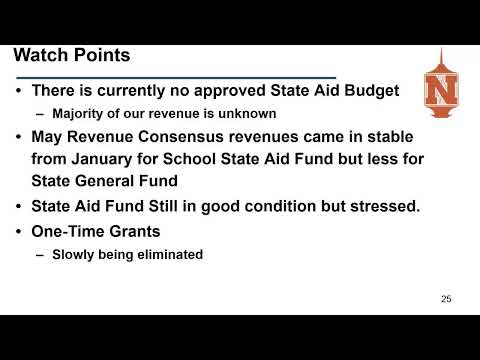
The hearing focused on the district’s assumptions and watch points rather than on final approvals; Mr. Kling repeatedly emphasized uncertainty in state funding and one‑time grants (referred to in the presentation as 31A and section 41) that could change the district’s final revenue picture. The board recessed the meeting at 5:57 p.m. and is expected to revisit budget amendments as state actions and local data become clearer.