Get Full Government Meeting Transcripts, Videos, & Alerts Forever!
Get email alerts on the Water Resources topic
No spam. Unsubscribe anytime.
City water staff report positive groundwater gains but commissioners warn growth and data centers pose risks
Summary
City water staff told the Indio City Sustainability Commission that Indio Subbasin groundwater storage showed a net gain in water year 24–25 and outlined upcoming regional planning and conservation actions. Commissioners pressed staff on future demand, data-center water use, AB 1572 compliance, and outreach plans.
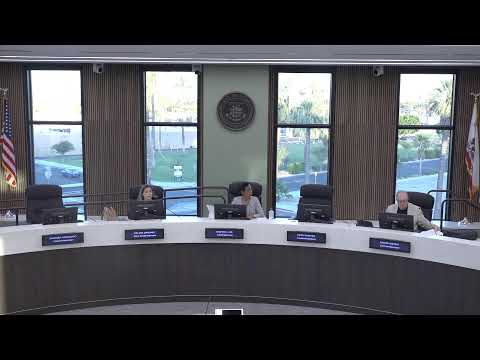
Roman Gonzalez, the city's water project construction manager, told the Indio City Sustainability Commission on June 22 that regional coordination and conservation drove a positive change in groundwater storage for water year 2024–25. "Based on the difference of inflows and outflows, the change in storage for the year 24–25 is approximately 137,000 acre-feet of water," Gonzalez said, citing replenishment via the Colorado River canal, increased recycled and canal water for irrigation, and conservation activities.
Gonzalez said the Indio Subbasin alternative plan update for 2027 is underway, with a draft expected in August 2026 and a final plan anticipated in December 2026. He also said the Coachella Valley regional Urban Water Management Plan remains on schedule to be submitted to the California Department of Water Resources by July 1, 2026, and includes a six-step water shortage contingency plan; staff said the city is currently in Stage 1, with measures such as minimizing irrigation runoff and limiting nonessential washing.
Commissioners pressed staff on how the city will balance expected growth and new uses. Commissioner David Gekka questioned whether trends and projections fully account for reduced Colorado River supplies and new development, especially water-intensive data centers. Staff noted that large residential projects (more than 500 units) must file water-supply assessments requiring the developer to demonstrate how supply would be met and said the Urban Water Management Plan and the SGMA (Sustainable Groundwater Management Act) analyses assume a 10% supply reduction in some projections.
Staff summarized conservation and funding programs available to residents and institutions. They reported approximately $300,000 remaining in Proposition 1 Round 2 funds for turf rebates and said the city was awarded about $800,000 through a water-and-energy-efficiency direct-install grant for turf replacement. The city also still offers rebates for smart irrigation controllers, turf removal, and efficient indoor fixtures, and runs outreach via CV Water Counts and online customer portals.
Commissioners and staff discussed AB 1572, the state rule that phases in prohibitions on using potable water to irrigate nonfunctional turf. Staff said AB 1572 information and contact details are posted on the City of Indio water authority website and that the city is beginning outreach to large commercial users (for example, golf courses) to help them register and explore funding opportunities to convert to nonpotable supplies.
Gonzalez concluded that regional planning, conservation programs and expanded reuse have contributed to short-term improvements in storage, but commissioners urged ongoing monitoring and careful review of assumptions when new large projects are proposed. The commission asked staff to return with more detailed metrics and suggested improving public-facing sustainability dashboards so residents can track water use and related performance indicators.