Get Full Government Meeting Transcripts, Videos, & Alerts Forever!
Get email alerts on the Transit topic
No spam. Unsubscribe anytime.
City urged to seek maximum transit operating grant as staff weighs microtransit options
Summary
Miss Ellis asked the East Grand Forks City Council to authorize applying for the full 2027 transit operating grant. She outlined funding splits, cost-allocation figures for fixed-route and Dial‑a‑Ride services, and two microtransit models that could replace Route 4 or co-mingle ondemand and Dial‑a‑Ride service.
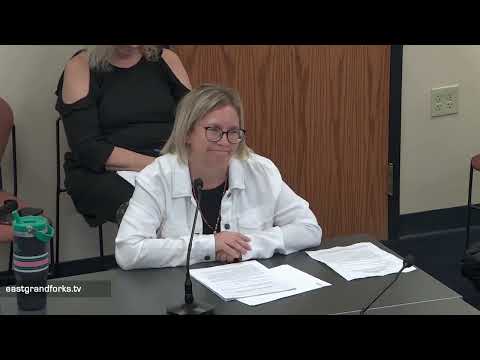
Miss Ellis told the East Grand Forks City Council at its June 23 work session that staff recommends applying for the maximum 2027 transit operating grant under Minnesota’s new performance-incentive funding formula. She said the city’s cost-allocation model places fixed-route annual operating costs at about $556,000–$557,000 and Dial‑a‑Ride at about $214,000, and described a preliminary maximum grant request of roughly $825,000.
"We do get some federal amounts that are allocated to us…so the total amount breakout is $219,000 of federal dollars, about $481,000–$482,000 state and $123,000 local," Miss Ellis said, explaining the mix the city would use to budget operations if awarded the maximum amount.
Miss Ellis outlined two possible microtransit approaches to improve service on the city’s north end. One would retire Route 4 and operate an ondemand microtransit circulation that connects riders to the nearest fixed-route connections while retaining Route 6. The other would co‑mingle ondemand trips with Dial‑a‑Ride dispatch, which would require setting mileage parameters that could limit some longer trips.
She provided preliminary cost comparisons: operating Route 4 currently costs about $194,000; combined with an estimated $54,000 reallocation for microtransit, staff’s estimate is roughly $250,000—close to the microtransit cost projected in the city’s study. "We think it's a viable option," Miss Ellis said of the microtransit alternative, and added that staff would likely target a spring-or-summer launch rather than beginning service in January.
Why it matters: Minnesota’s shift to a performance-incentive grant formula means available dollars will be linked to measures such as service productivity and vehicle hours; applying for the maximum amount gives the city flexibility to plan fixed-route, Dial‑a‑Ride and potential microtransit operations within a known upper bound of funding.
Next steps: Miss Ellis asked council to approve submitting the grant application at the proposed maximum level; she offered to provide detailed cost-allocation documents to council members on request.