Get Full Government Meeting Transcripts, Videos, & Alerts Forever!
Get email alerts on the Housing Study topic
No spam. Unsubscribe anytime.
Cochise County hears first countywide affordable housing study, consultant urges targeted investments
Summary
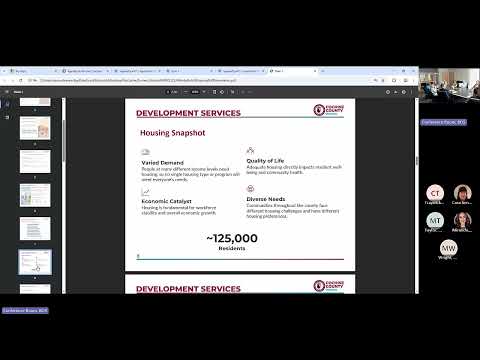
Consultants presented a countywide affordable housing study recommending targeted investments in high-need unincorporated communities, a local housing trust fund, and expanded partnerships and financing tools to address a roughly 13,000-household affordability gap, the board heard June 25.
Consultants presenting Cochise County27s first countywide affordable housing study told the Board of Supervisors on June 25 that rental affordability is the county27s largest housing challenge and that targeted investments are needed in high-need unincorporated communities.
"No household should spend more than 30% of their income on housing," consultant Rick Merritt said, explaining the study27s affordability benchmark and the distinction between low-income households eligible for federal and state subsidies and workforce households that must be served locally.
The study, funded entirely by a grant from the Arizona Department of Housing, analyzed demographic trends, housing supply and affordability, and barriers to development. Merritt said two-thirds of county housing is single-family, about one in five units is a manufactured home, and the typical unit is roughly 43 years old—conditions that complicate rehabilitation and safety upgrades.
Merritt summarized key findings: a large affordability gap affecting an estimated 13,000 households, renter median incomes substantially below homeowner medians, and concentrated needs in several unincorporated communities the report flagged for priority action. "We want to preserve and rehabilitate the existing housing stock," Merritt said, adding that production of affordable workforce housing and expanded funding partnerships are priorities.
To increase production and lower costs, the report recommends a set of strategies including establishing a local housing trust fund, promoting low-income housing tax credit and USDA rural housing opportunities, using industrial development authorities for gap financing, and dedicating staff to housing implementation. Merritt listed five unincorporated places the study identifies as high priority: Alfreda, Senzona, Buoie, Nako and Wetstone.
The consultant also encouraged the county to pursue pre-development and infrastructure planning to support projects in rural areas where wells, septic and utilities add significant costs. "Target limited resources to the highest-need communities," Merritt told supervisors, emphasizing tracking progress and updating priorities annually.
The presentation concluded with a discussion of financing tools and competition for tax credits; Merritt noted newer tax-credit projects often carry longer affordability periods and that local gap financing can improve an application27s competitiveness.
The board scheduled follow-up staff work and said it may consider legislative requests before the August submission deadline to pursue measures that would enable local options identified in the plan.
The study and consultant recommendations will be available as staff refines an implementation timeline and funding strategy.