Get Full Government Meeting Transcripts, Videos, & Alerts Forever!
Get email alerts on the Water Service topic
No spam. Unsubscribe anytime.
Resident says city told him to install hydrant to get water service for Walker Street lot
Summary
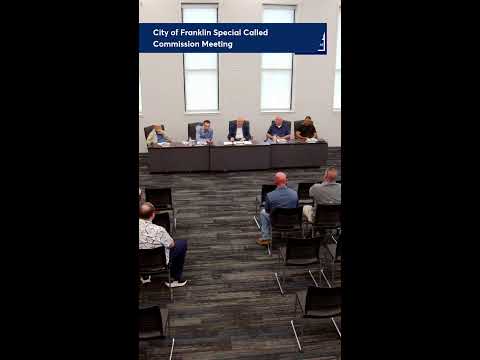
At the June 22 Franklin City Commission meeting, Donnie Briggs said city utility staff told him he must engineer and install a main and fire hydrant to obtain water service for a lot he bought near Walker Street; commissioners and staff explained distinctions between service and main extensions and cited state review requirements.
Donnie Briggs told the Franklin City Commission on June 22 that he paid $70,000 for a lot near Walker Street and later was told by the utility he must install a fire hydrant and have an engineered water main extension to secure water availability.
"Why would I put a damn fire hydrant in when it's that close?" Briggs said, arguing that an existing hydrant sits within about 150–220 feet of his lot and that staff had previously marked a blue line indicating a water line. He said he filled out a water availability survey and received inconsistent explanations from the utility and that he cannot afford the engineering and installation costs he was told would be required.
Commissioners and staff explained how water service differs from main extensions. A main extension or sewer main extension must be engineered and approved by the utility, and the city noted those projects are reviewed by the utility and, in some respects, by state rules. Staff said a main (4-inch or 6-inch) differs from a 3/4-inch service line, and the proper size and whether a hydrant or a blow-off is needed depends on development plans and the line configuration.
One staff member estimated engineering and installation for a main and hydrant could total in the tens of thousands of dollars. Briggs said he had planned rezoning and possible mini-storage for the 1.4-acre parcel and was concerned that new water requirements would limit his options. He said he had previously divided other lots without appearing before the commission and that the change in direction felt inconsistent.
City staff advised Briggs that developers normally present a development plan at a development meeting so the city can assess water and sewer needs and that the availability process includes written stipulations. Staff confirmed they had received a recent water availability request from Briggs and that fees and engineering requirements would be applied per current rules.
The commission did not take formal action on the request. Commissioners and staff urged Briggs to work with planning and utilities to clarify available options and the specific development standard that applies to his parcel.