Get Full Government Meeting Transcripts, Videos, & Alerts Forever!
Get email alerts on the Water Infrastructure topic
No spam. Unsubscribe anytime.
Resident presses city on water-availability finding and proposed hydrant on Walker Street lot
Summary
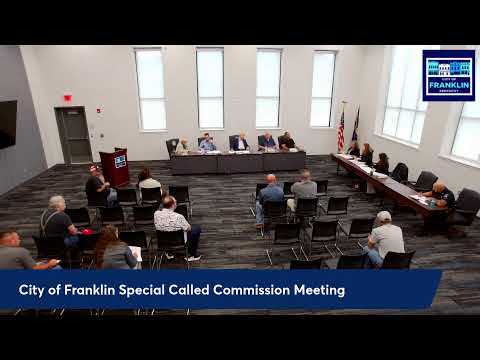
At a City of Franklin commission meeting, resident Donnie Briggs said city staff told him he must install an engineered water-main extension and a fire hydrant to develop a lot on Walker Street; he disputed that requirement and the fees and asked the commission for clarity.
Donnie Briggs told the City of Franklin commission during public comment that he paid $70,000 for a lot across from 500 Walker Street but has been told he must install a fire hydrant and an engineered water-main extension before getting water service.
Briggs said the nearest hydrant is roughly 150–220 feet from his corner and that contractors and city employees previously marked lines at the site before a purchase. “Why would I put a damn fire hydrant in when it's that close?” Briggs said, adding later, “Y'all full of it,” as he described frustration with inconsistent guidance from staff.
City staff responded in the meeting that water-main extensions require engineering approval and state review, and that for line extensions the city typically requires either a blow-off or a hydrant at a dead end to allow flushing and provide fire protection. A staff member noted that “water main extensions or water sewer main extensions has to be engineered [and] approved by the division.”
Briggs said he was willing to pay for a service line but questioned why he would be required to fund a full main and hydrant given existing nearby infrastructure. Staff explained the difference between a service line (for individual service connections) and a main (4– or 6‑inch lines sized for development), and said final requirements depend on the planned development and engineering review.
The exchange did not produce an immediate change in policy. Commissioners and staff advised Briggs to pursue formal water-availability paperwork through planning and zoning and to request clarification from the water department and, if necessary, state inspectors. The commission did not take action on the matter during the meeting.