Get Full Government Meeting Transcripts, Videos, & Alerts Forever!
Get email alerts on the Education Technology topic
No spam. Unsubscribe anytime.
Wyoming committee weighs device funding, screen‑time limits and AI risks as districts point to hidden infrastructure costs
Summary
Consultants told the select committee that Wyoming’s current $250-per-ADM technology allocation (1 computer per 3 students) understates some district needs; an alternate model estimates about $450 per ADM. Witnesses — superintendents, parents, teachers and tech directors — urged grade‑banded policy, clearer evidence on screen‑time limits and more staffing for cybersecurity and system maintenance.
Consultants and school leaders told a legislative select committee that decisions about whether to fund one device per student should be guided by explicit trade-offs — and that many technology costs districts face today are not captured by the existing per‑student allocation.
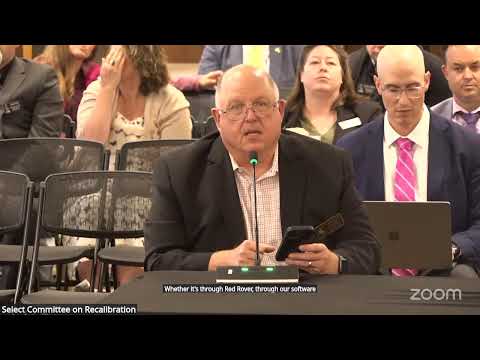
At a hearing focused on school finance recalibration, a consultant team presented a simulation the committee can use to compare scenarios ranging from the current model (about $250 per average daily membership, or ADM) to a more expansive estimate. "The EB model estimated $450 per ADM," the presenter said, summarizing an upper‑bound scenario when replacement cycles and higher per‑device costs are assumed. The model ties device counts to grade‑level ADM and allows districts to test replacement cycles and staffing assumptions.
Why it matters: lawmakers must choose whether the state funds 1:1 device access (one computer per student), a shared‑device approach, or a hybrid that varies by grade. That choice affects capital replacement, network capacity, software licensing and the technical staff required to keep those systems running.
Committee members and witnesses emphasized three practical constraints. First, research on screen time is mixed, and a repeated theme in testimony was that instruction quality — not simply device presence — drives learning outcomes. The presenter summarized LA Unified School District’s draft screen‑time policy, which proposes near‑zero device time for preschool and kindergarten, 20–30 minutes per day for early elementary, and 90–180 minutes for high school, and said the district’s policy draws on a literature review rather than a single decisive trial.
Second, many parents, teachers and students said classroom reality has shifted toward easier grading and classroom management on devices, sometimes at the cost of teacher‑led instruction. A recent student testified that being assigned to use ChatGPT or Grammarly “felt like I lost my ability to think for myself,” and urged restricting AI access in classrooms unless carefully supervised.
Third, technology directors and business managers pressed the committee to account for infrastructure and staffing. Park County’s technology director outlined recurring costs — servers, virtualization, access points, cybersecurity protections and dozens of cloud subscriptions — and said his district spends six‑figures annually on non‑student subscriptions alone. Several tech directors recommended a working group to reassess staffing assumptions; the current model’s tech FTE assumptions, they argued, do not reflect database reporting, cybersecurity obligations or the number of cloud services districts now must maintain.
What witnesses recommended
- Grade‑banded approach: multiple witnesses urged different device policies by grade (limited, cart/lab access in K–2; targeted access in 3–5; 1:1 in 6–12 with varied take‑home policies). - Evidence and documentation: presenters agreed to provide the committee with additional documentation on LAUSD’s review and a deeper simulation of how Utah’s liquor‑tax earmark for meals is distributed; committee members asked for more literature and citations to underpin time‑limit proposals. - Staffing review: tech directors asked the legislature to evaluate whether statewide tech‑staffing assumptions align with modern responsibilities (SIS reporting, cybersecurity, door and camera systems, transportation systems and district subscriptions).
What the committee will do next
No formal votes were taken. The consultant agreed to supply follow‑up documentation on Utah’s distribution of liquor‑tax funds for school meals and to refine simulation outputs for the committee’s next meeting. Lawmakers signaled interest in more granular, grade‑banded costing and asked staff to consider whether a working group should study technology staffing and the budgetary proxy used for devices.
The committee recessed for a scheduled lunch and planned to reconvene at 1:30 p.m.