Get Full Government Meeting Transcripts, Videos, & Alerts Forever!
Get email alerts on the Signage topic
No spam. Unsubscribe anytime.
Zoning board denies pylon-sign variance for Old Perry Highway childcare site; suggests monument-sign alternative
Summary
The Town Zoning Hearing Board declined an application to allow a pylon sign with a digital display at 8633 Old Perry Highway, citing code limits on digital displays and concern that a monument sign could meet visibility needs; the applicant said the LED unit was already purchased and was urged to reapply with revisions.
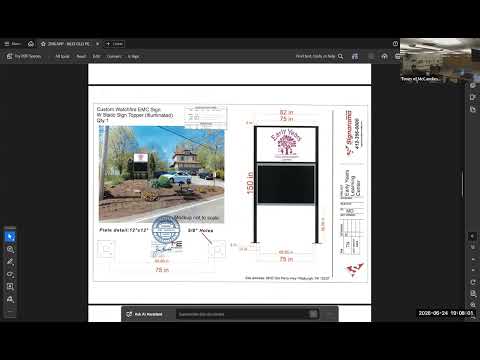
The Town Zoning Hearing Board on June 24 considered Appeal 2057, a request to allow a pylon sign with a digital display at 8633 Old Perry Highway, a parcel occupied by Early Years Childcare Center (formerly Tender Care). Attorney Dean Phillips represented the property owner and said the lot’s angle, setback and the curvature of nearby roads make the building difficult to see, creating a safety and access issue that a taller pylon sign would alleviate.
The board’s discussion centered on whether the application improperly combined multiple variances — permitting a pylon sign in the neighborhood-center (MN) district and allowing a digital/display (LED) element that board members said is not generally permitted there. Board member Scott Mezer questioned the digital-display allowance, asking whether “digital display is not permitted in the MN district by code,” and urged the applicant to consider lowering the sign height or removing the digital element to stay closer to code intent.
Board members also pointed to an available, code-compliant option: a monument sign. Art, a board member filling in for an absent colleague, told the applicant the neighborhood-center rules permit monument signs up to 8 feet tall (two are allowed) and argued that two monument signs set back from the line could provide visibility from both Old Perry Highway and Route 19 without granting a pylon or digital-display variance. Aaron, a board member who said he does not vote but lives nearby, said the application was a hard case for a variance and flagged resident proximity behind the parcel.
The applicant and owner said the proposed pylon would meet standard height and size limits for pylon signs where permitted, and that the LED/digital portion would meet display-size limits where such displays are allowed. Dean Phillips also offered that the sign’s LED face could be made available to the township for emergency notifications. The applicant added that, because of earlier confusion, an LED sign had already been purchased and replacing it would be costly.
After board discussion, a motion to grant the variance to allow a pylon sign with a digital display was made and seconded. The roll call recorded two ‘nay’ votes; the transcript records those negative responses but does not attach names to the recorded nays. The board’s comments and the recorded negative votes left the application without the necessary support, and members urged the applicant to redesign or reapply — for example, by pursuing a monument-sign application or submitting a narrower variance request focused only on illumination.
Next steps: the board advised the applicant to consider a new application for a monument sign or a revised variance request that removes the digital-display component; the applicant acknowledged the suggestion but noted the sunk cost of the purchased LED sign. The meeting adjourned at 7:33 p.m.
Sources: town Zoning Hearing Board meeting transcript, June 24, 2026. Direct quotes and attributions are drawn from board discussion and testimony at that hearing.