Get Full Government Meeting Transcripts, Videos, & Alerts Forever!
Get email alerts on the Foreign Policy topic
No spam. Unsubscribe anytime.
Senator says Iran war was reckless, warns Trump memorandum yields large concessions
Summary
On the Senate floor a senator called the recent U.S. military action in Iran "reckless and illegal," saying it cost lives and money and that a memorandum of understanding signed by Donald Trump effectively restores Iranian oil sales and pauses Strait of Hormuz restrictions for 60 days without securing a robust nuclear verification plan.
A senator on the floor criticized recent U.S. military action in Iran and a memorandum of understanding signed last week by Donald Trump, saying the conflict produced heavy costs and few strategic gains.
The senator said the human and material toll was stark: "13 American service members are dead. Thousands of Iranians have been killed. We spent tens of billions of dollars," and he cited economic fallout including prices that "shot up to $5.70 in Hawaii," as immediate consequences of the campaign.
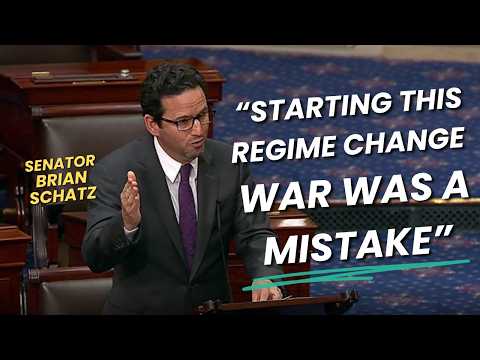
He faulted the decision to start the campaign rather than pursue diplomacy. "The mistake is not ending the war. It was starting it in the first place," the senator said, arguing every day of the fighting "only compounded that catastrophe." He urged that diplomacy remain the "only viable path forward."
The senator contrasted the new memorandum with the earlier Joint Comprehensive Plan of Action (the JCPOA), saying the prior agreement allowed intrusive International Atomic Energy Agency inspections and third-party custody of sensitive materials. He said the current deal does not restore those verification safeguards and represents a poorer bargain: "we had a joint comprehensive plan of action...now what we have is an opening to negotiate," he said, warning that, at best, the U.S. might return to conditions from 12 years ago.
He also warned of wider geopolitical and commercial consequences. Citing the Strait of Hormuz, he said the passage is "open again but only for 60 days after which Iran is reserving the right to charge a fee for ships to pass," calling such a provision "unprecedented" for freedom of navigation and harmful to global commerce.
On sanctions and economic pressure, the senator said the memorandum will allow Iran to sell oil "freely on the open market for the first time in 30 years," and he warned this represents a multigenerational reversal of bipartisan policy meant to curb Tehran's regional influence.
Summing up, he urged lawmakers of all foreign-policy persuasions to adopt what he called "logical foreign policy," to recognize Iran as a belligerent actor, and to be cautious about kinetic engagements that lack a clear strategy. He concluded his remarks by yielding the floor.
The Senate record shows these were floor remarks; the speech contained no formal vote or motion reported in the transcript.