Get Full Government Meeting Transcripts, Videos, & Alerts Forever!
Get email alerts on the Veterans Discharge Upgrades topic
No spam. Unsubscribe anytime.
Advocates say streamlined discharge upgrades and outreach are needed for veterans with 'bad paper'
Summary
On the Legal Services Corporation podcast Talk Justice, legal and veterans advocates said unfavorable military discharges, often tied to discrimination or untreated trauma, block veterans from benefits and services and urged expanded outreach, easier upgrade processes and more legal aid capacity.
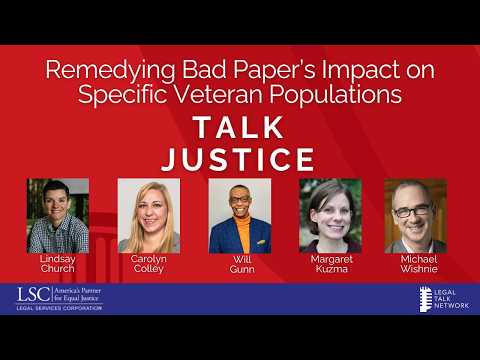
Will Gunn, general counsel at the Legal Services Corporation, convened a panel on the LSC podcast Talk Justice to discuss how unfavorable military discharges — commonly called “bad paper” — affect veterans and what legal-aid organizations can do to help. "Equal access to justice is a core American value," the episode opens, and panelists said that principle applies to veterans trying to correct discharge records.
"Not all service looks the same," said Lindsay Church, executive director and co‑founder of Minority Veterans of America, arguing that identity and lived experience shape who receives punitive or administrative discharges. Church said bias and retaliation in the military justice system contribute to higher rates of adverse discharge outcomes for veterans of color, LGBTQ+ veterans and survivors of military sexual trauma.
Panelist Mike Wishnie, clinical professor of law at Yale Law School and director of its Veterans Legal Services Clinic, described the scale of the problem and the legal pathways for relief. "There are tens of thousands of former service members who have been discharged with bad paper, often wrongly so," he said, and noted that Congress created review boards so veterans could apply to correct errors or injustices. He summarized the legal standard as: "it's just unfair," meaning an applicant need show an error or injustice to qualify for an upgrade.
The panel reviewed concrete consequences of non‑honorable discharges: veterans with "bad paper" can lose eligibility for Department of Veterans Affairs benefits such as health care, educational benefits, burial benefits and disability compensation. The group also discussed public‑health implications: Carolyn Colley, a VA attorney speaking in a personal capacity, said veterans are 1.5 times more likely to die by suicide than non‑veterans and that, when controlled for gender, women veterans are 2.2 times more likely to die by suicide than comparable non‑veteran women.
Panelists traced causes and barriers. Margaret Kuzma, an attorney at Harvard Law School's Veterans Legal Clinic and author of a new discharge upgrade practice manual, said boards historically were harsh and under‑resourced but have improved in recent years. She pointed to practical reforms such as telephonic and video hearings, online submission portals, and automatic referral notices that can improve access. "Representation can make such a difference," Kuzma said, urging legal‑aid offices to screen clients for discharge‑upgrade eligibility and to use the manual's step‑by‑step guidance.
Despite some procedural improvements, the panelists said substantial outreach and assistance are still missing. Wishnie said the Department of Defense has declined repeated requests to actively notify veterans who may be eligible for upgrades — including large cohorts discharged under historic anti‑homosexual policies — leaving most veterans to seek redress on their own. Church gave the illustrative example of Kei Ou, a Marine who reported an assault, was detained and isolated, later released and received a bad‑paper discharge.
All four panelists recommended practical steps for legal‑aid and community providers: screen veteran clients for upgrade eligibility; develop partnerships with law clinics, veteran service organizations, VA offices and community services; and provide trauma‑informed, culturally competent outreach, especially for minority veterans. Kuzma emphasized that non‑attorneys such as veteran service officers can help prepare effective applications.
The episode closed with Will Gunn thanking the guests and repeating the Legal Services Corporation disclaimer that guest views were their own and the conversation was informational, not legal advice.